



 Video
VideoUnfortunately, if you have to sit for extended periods of time for work or other reasons, developing and maintaining a correct, elastic position in the saddle can be challenging. Proper rider position affects everything—your horse’s rhythm, his longitudinal and lateral balance and his willingness to go forward and come back. It also makes your aids more clear. But as riders very well know, finding and keeping your balance on a living, breathing, moving animal is an enormous challenge. Some people compensate by hanging on to the reins or gripping with their legs or tightening their backs. The result? Your horse is heavy; he won’t go forward or he won’t bend.
To become more effective riders, we have to look at the parts of our bodies that don’t move in harmony with our horses. Some of us have tight legs; others have tight lower backs, braced hips or rigid arms. All these issues inhibit your horse’s ability to move freely. Your body type can also affect your position. I have a longer waist, for example, so maintaining a neutral spine and not allowing my back to hollow when my horse loses his balance and comes against the contact is a challenge I continually work on.
Here, I’ll explain why sitting for too long can impede your position and offer exercises and posture tips that you can practice out of the saddle to offset the time you spend at your desk. Plus, I’ll provide mounted exercises that you can incorporate into every ride to loosen up your hips and lower back to help you maintain a correct position while following your horse’s motion.
Impediments to Correct Position
Many of my students work at desk jobs or drive long distances to get to the barn and it affects their position in the saddle. Their heads might be a bit forward or their core is collapsed and their shoulders are rounded. It’s very difficult to sit correctly on your horse if you’ve been sitting for a long time in front of a computer or behind the wheel.
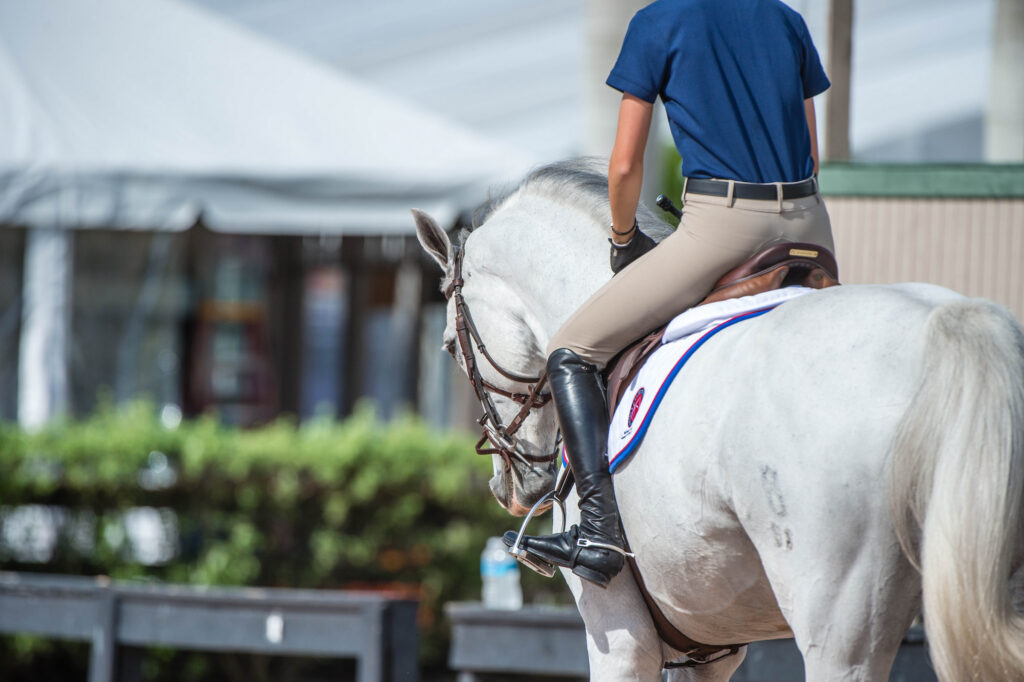
Sitting for extended periods tightens your hip flexors, hamstrings and quadriceps—the very muscles you need to be flexible and supple in the saddle. When these muscles are in a contracted state for too long, it weakens the glute muscles, limits hip mobility and puts undue stress on the lower back. Awareness of proper spinal alignment throughout the day is so important. It will help train the muscles you need in the saddle.
Strength training, Pilates, stretching and many other activities are absolutely beneficial to balance muscles that you over- or underuse when riding. Your core muscles can be strengthened outside of the saddle, but be mindful that you strengthen them in the saddle as well. Keeping a healthy balance of work in and out of the saddle will give you many years of comfortable, fun and effective riding and alleviate a lot of structural issues for you and your horse.
Unmounted Exercises and Posture Pointers
As equestrians, working to adopt correct posture as a way of life can also go a long way in improving your position and ability to use your aids independently. If you have a desk job that requires you to sit for long periods of time, try the following:
- Be aware of your posture throughout the day to avoid slouching or crunching your neck while looking at your computer. (There are even “posture correctors” available that can help you maintain proper spine alignment while sitting or standing, such as the ShouldersBack® by EquiFit.)
- If possible, break up your day with exercise. If your gym is nearby or your office has workout facilities, sneak in a workout on your lunch break. Or simply go outside and take a walk. If you’re lucky and work from home, do a Pilates or yoga session (there are lots of free yoga and Pilates videos available on streaming apps).
- Stretch as much as possible!
- Yoga, yoga, yoga: You’ve heard it before, but yoga works miracles to help you stretch key muscles, tendons and ligaments and give your spine all of the twisting and stretching necessary for proper alignment and posture in the saddle.
- Participate in exercise “snacks”: Get up from your desk every 30 minutes and walk around for 3 to 5 minutes.
- Try a standing desk. Available in a wide variety of styles and price ranges, most standing desks are convertible, meaning they give you the option to stand or sit. When using a standing desk, however, make sure you don’t inadvertently lean into one hip or the other; try standing with a wider stance to make sure your weight is distributed evenly.
- Use an exercise ball for part of the day. Sitting on an exercise or stability ball while at your desk can improve your core strength and posture.
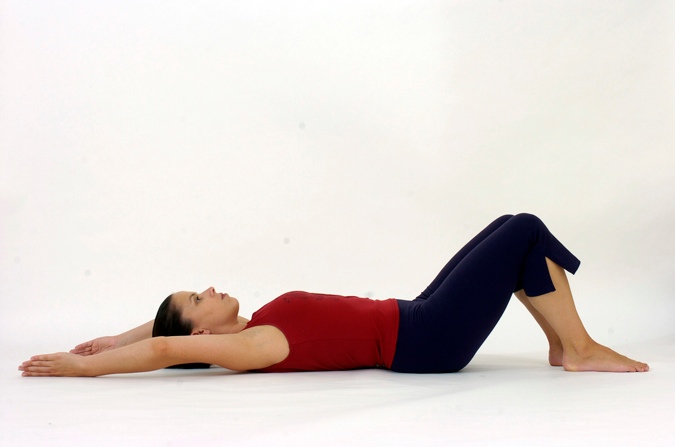
Exercise 1: Loosen Your Hips, Legs And Lower Back
Every day when I get on my first horse, I do an exercise that I also encourage my students to do. Most of us get in the saddle, put our feet in the stirrups and off we go to ride, not taking the time to recognize tension in the hips, legs and lower back. Try this to loosen those areas:
1. Sit in the saddle and drop your stirrups.
2. Draw your legs up and over the top of each side of your saddle, close to the pommel. From there, grab the pommel with one hand and the cantle with the other and pull your hips as close to the pommel as you can.
3. Let your legs drop back down against your horse’s sides. You will feel a big stretch in your hip flexors, psoas (the muscles that connect your lower back to the top of the thighs) and inner thigh muscles and, quite possibly, a lot of tightness the first few times you do it.
4. Continue to feel your legs stretching down and try to find the three points of contact in your seat as you walk on a loose rein around the arena for 15 minutes.
Takeaway
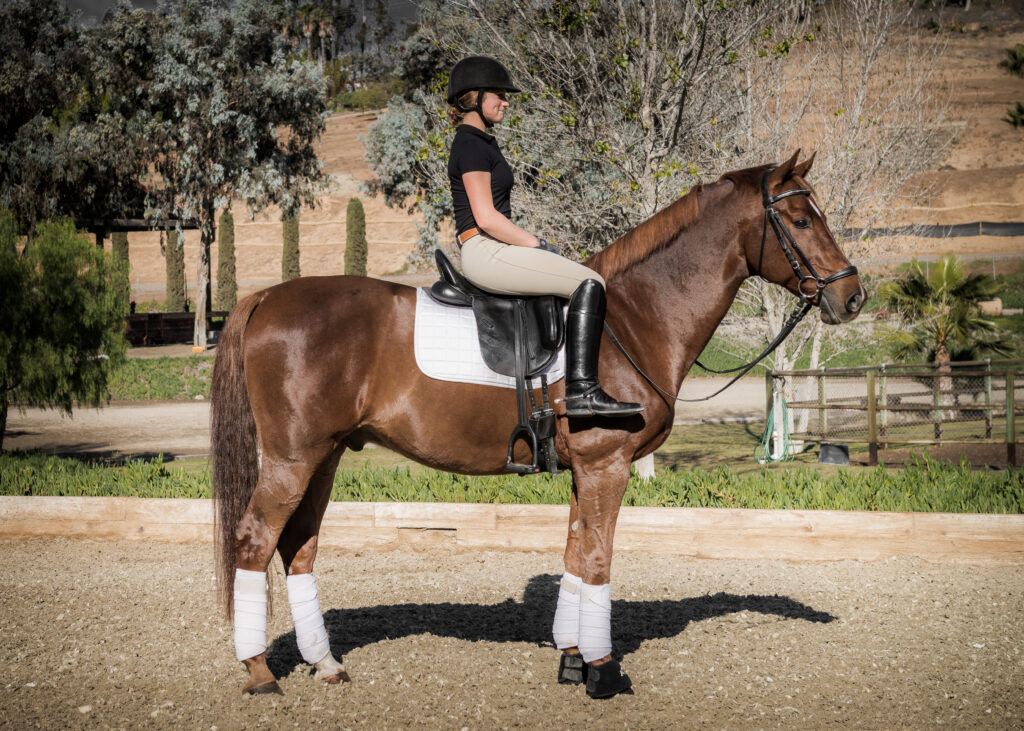
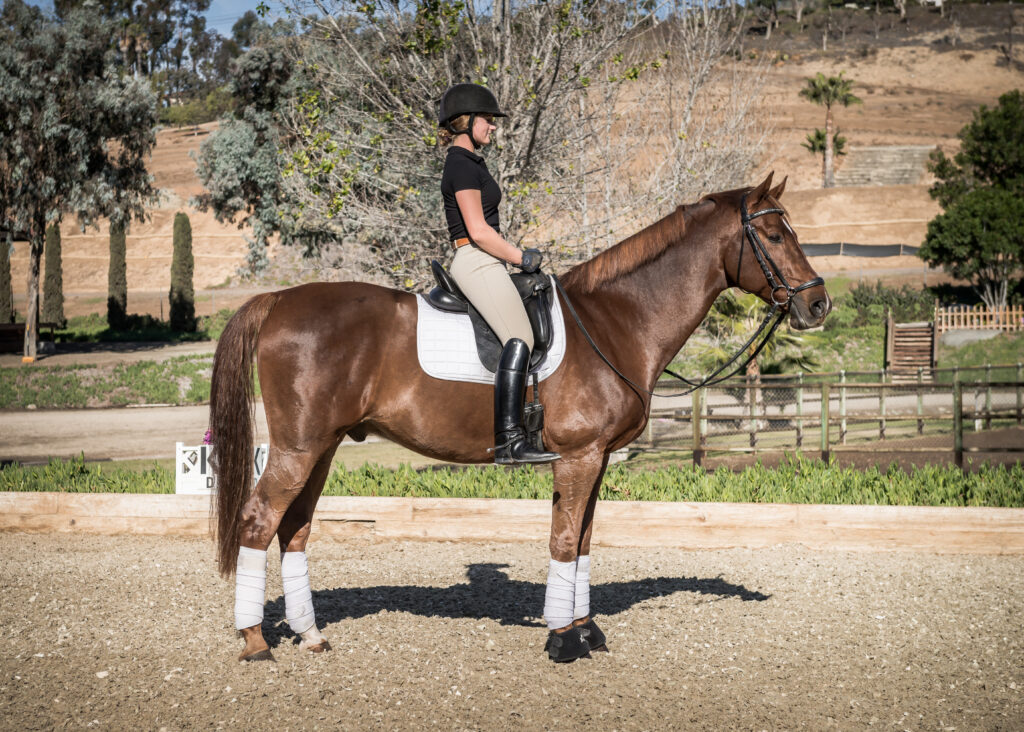
If you watch riders like my husband, Steffen Peters, or Guenter Seidel, Helen Langehanenberg or Ingrid Klimke, you’ll notice that their bodies seem to exactly match their horses’ movements. They move with their horses as a unit, as if their core structures are working together. That should be the goal for all of us. It’s our job to work with our conformation and that of our horses to find our core strength and balance in the saddle and maintain them every single time we ride.
About Shannon Peters
Shannon Peters is a popular clinician and teacher as well as coach to her husband, three-time dressage Olympian Steffen Peters. Shannon began riding and competing in Western and saddle seat in her native Michigan. College took her to Boulder, Colorado, where she developed a successful dressage training business before moving to San Diego in 2002. After Shannon married Steffen in 2004, the pair started SPeters Dressage in San Diego. A USDF bronze, silver and gold medalist, Shannon is a three-time national championship competitor: on Luxor in 2007 when the two were crowned Reserve National Champions Intermediaire I; on Flor de Selva in 2009 when they took home fourth place in the Intermediaire division; and on Akiko Yamazaki’s Odyssey in 2011 after winning the Grand Prix Special at the Del Mar and Burbank CDIs in California. With Jen and Bruce Hlavacek’s Westphalian gelding, Weltino’s Magic, Shannon won Reserve National Champion in the 6-year-old division at the 2008 Markel/USEF Young Horse Championships, and Steffen won team and individual gold medals at the 2011 Pan Am Games in Guadalajara, Mexico.