




 Video
VideoFour years ago, a little chestnut Thoroughbred with no microchip and no rated-show record shipped from Florida to Connecticut as a sales project. Today, that horse, known in the show ring as Even Better and called “Niven” at home, is jumping FEI grand prix tracks.
The rider who got him there, Michel Feitosa, credits one training tool above all others for the transformation: gymnastics.
An Underestimated Horse
Niven came into Feitosa’s life through his wife, Amanda Picciotto Feitosa. A friend of Amanda’s owned the then 10-year-old gelding (Lemon Drop Kid x Offshore Breeze, by Thunder Gulch) and was looking to sell him.
Bred by Peter E. Blum Thoroughbreds LLC in Kentucky, Niven sold for $190,000 at the 2013 Keeneland September Yearling Sale but never started a race. After a professional restart, he spent his early years in the hunter/jumper world being ridden by juniors and amateurs.
“He was basically a horse with an easygoing demeanor, but they didn’t really believe he was something special,” Michel says of how the horse was viewed at his previous barn.
Amanda remembers it the same way. “My friend always liked him and thought he was a great horse,” she says. “But her trainers, the professionals at her barn, never really were that interested.”
Michel initially figured Niven would top out well below the levels he now competes at, but he thought that the horse would be a great partner for a junior or amateur rider.
“He was a little bit of an older horse to develop,” he says. “In my mind, he was going to be more of a horse to put a client on, to jump some smaller fences.”
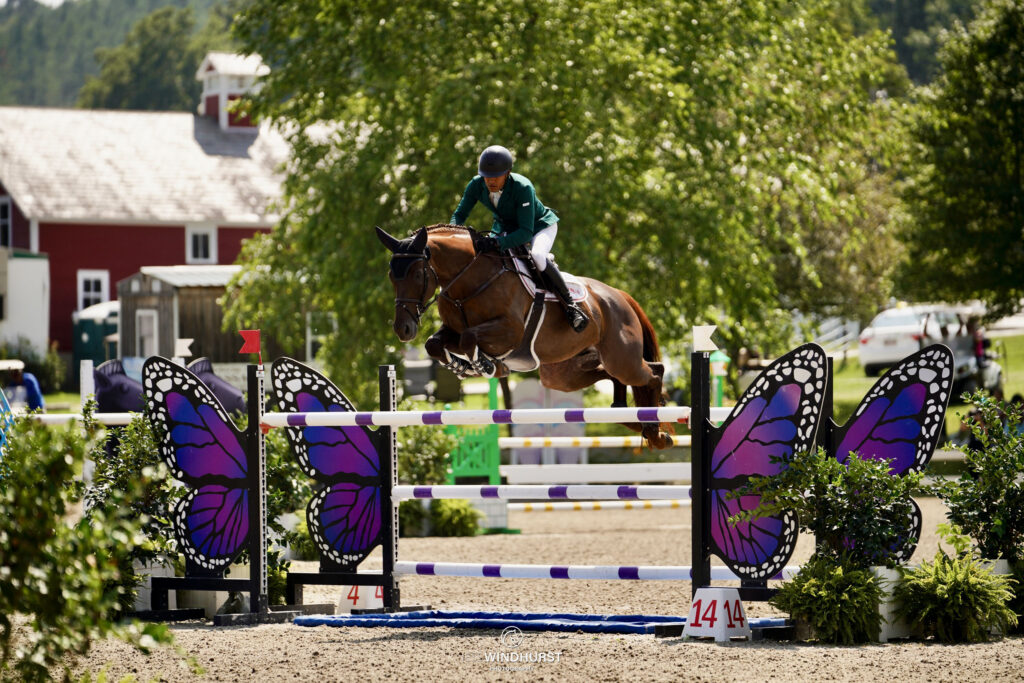
That assessment changed once Michel started jumping him.
“The first time I did a course with him, he gave me a very good feeling,” he says. “I felt a lot of power, I felt his engine. When he jumped the first course with me, it was very different than when I was jumping some cavalletti. Flatting him, he felt like just a lazy horse, not so powerful, but sweet and cute. And then when I jumped a course, it was a small course, but it really felt like he could have something special.”
Michel described the horse’s early temperament in the ring as green but honest. “He was always a horse who was very brave and wanted to do the right thing, but he didn’t really know how to do it,” he says.
Enter: Gymnastics
It didn’t take long for Michel to identify a gap between Niven’s raw ability and his technique.
“He felt like he had a big engine, a lot of scope and ability, and he would try to solve the problems always using power,” Michel says. “The other thing is that he would always shoot forward. The takeoff would be very flat and forward, and he was always landing very far away from the jump—not thinking about going up and round. Always like, ‘I’m going to go to the other side, if I hit the pole or not,’ He wasn’t reading the jump, thinking, ‘What can I do to jump it clear?’”
The fix, Michel decided, was gymnastic work. While most horses in his program at Halcyon Show Stables, based in Litchfield, Connecticut, and Wellington, Florida, might see a gymnastic exercise once a month, Niven jumped through a grid once or twice a week. One recurring issue shaped much of the early work: what Niven did after he landed.
“He was a horse who I always did a few jumps in a row with, because of the problem I always had after the jump, that he would just kind of put his head down and drag me around, not thinking about the next jump,” Michel says. “So he always needed a jump after, to make him jump a little more round.”
In the beginning, that meant short, simple grids. The pair started with simple one-stride to one-stride or one-stride to two-stride lines, using placing poles between those fences to help Niven jump in a rounder arc to land closer to the jump and be able to rebalance himself sooner. Then at the far end of the exercise, there was another element waiting.
“For him, always, at the end of the gymnastic, we have something after—a pole, a cavalletti—to make him land and get him to balance himself a little bit, so he doesn’t just continue,” says Michel.
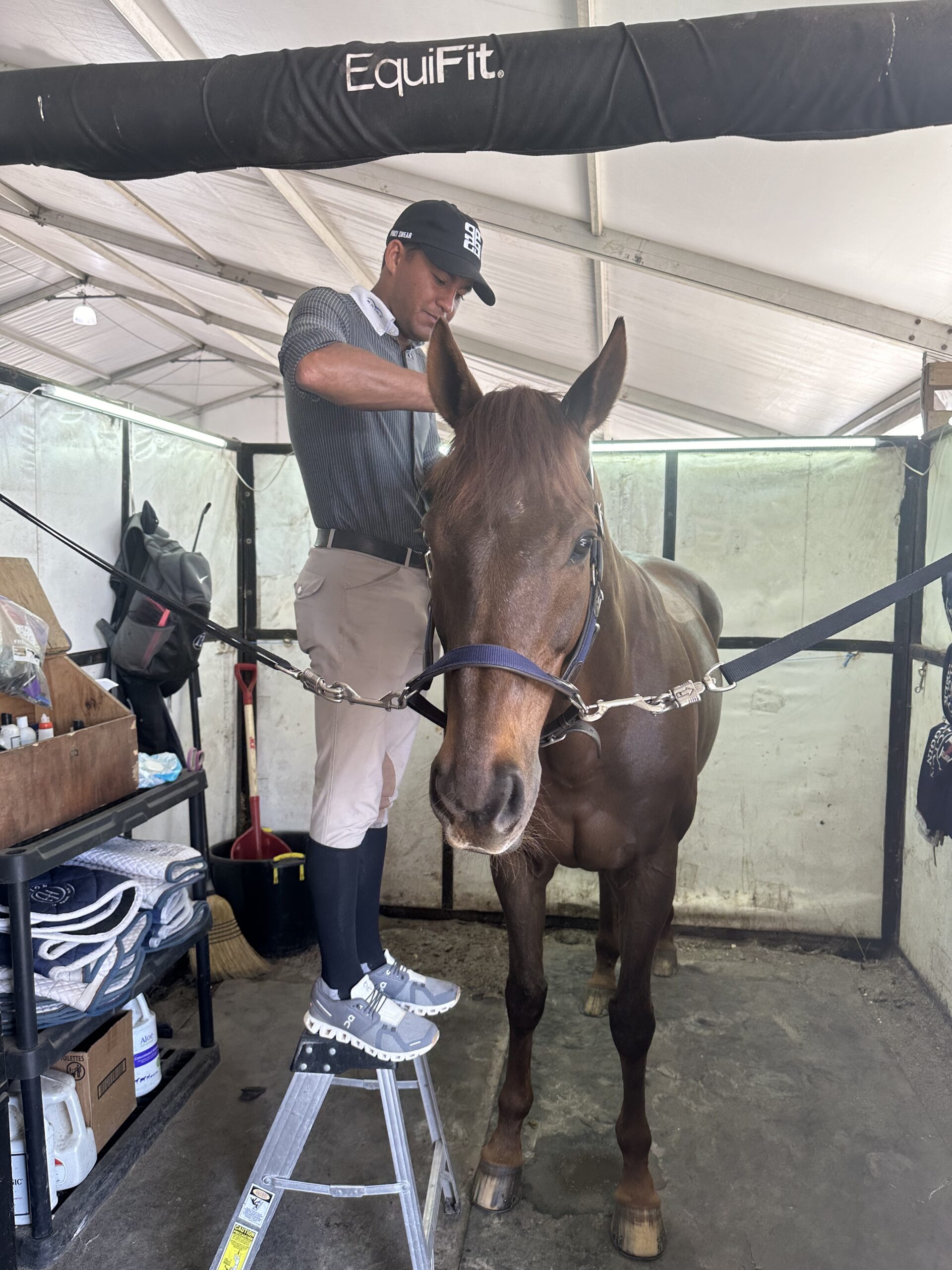
As Niven matured into the exercises, the lines grew.
“His gymnastics, once he got used to it, would be four, five, six jumps in a row,” Michel says. “At some point, I could do 10 little bounces. Today, I can put a triple combination in front of him like he might see at the shows, and he reads it and understands it much better because of all the work we have done with the placing poles and cavallettis.”
Michel worked to reshape how Niven covered ground between fences. Because the gelding landed so far out in the beginning, standard combination distances rode short and awkward for him.
“My goal was to make him back himself off of the jump a bit and be more comfortable to jump a combination when the distance between the jumps was shorter for him,” Michel says. “He has a good stride, a normal stride, but he lands so far that it makes the distance between the jumps ride short for him.”
Rather than confronting that problem head-on, Michel addressed it gradually with the exercises. “What I would do, to not get him scared, is I would set a normal distance that’s comfortable for him,” he says. “He would feel good, and I would make it a little bit shorter and shorter, so he would start to feel comfortable with that shorter distance.”
At the early stage, Michel says he was careful about not pushing too far, too fast.
“The problem with gymnastics is you have to be careful not to make them use their body too much in a way that they don’t understand, because it will affect the brain,” he says. “They always need to see a challenge they can finish and feel good about themselves and feel like they learned something.”
If a session wasn’t going as well as he wanted, Michel just scaled back.
“I would make the exercise as small as possible,” he says. “I would take two jumps away, and I would make him feel like he can do it. It’s more important for me to give him confidence than to challenge him so much that the next day he’s going to be afraid of doing it.”
Watching from the rail gave Amanda a different view of Niven’s learning curve than Michel had from the tack.
“You could see in the beginning that Niven did not totally understand how to do what he was being asked,” she says. “He was very earnest, and he always was trying. But he would get almost stressed when he didn’t understand. You could see he was like, ‘I don’t get this, and I want to do a good job, but I’m not sure that I’m doing a good job.’
“You expect an older horse to just sort of figure it out,” she adds. “If you put a 2-year-old warmblood that was bred to jump into a free-jump chute, you see right away that horse knows how to jump, totally automatic. Niven did not have that. He had all the power and all the heart and the desire to be a good boy, but he did not have that natural technique to jump. I think Michel sort of created that for him, and now he understands.”
Niven and Michel jumped their first grand prix together in June 2024 at the $30,000 Grand Prix of Princeton in New Jersey, and that fall, the pair moved into FEI competition, debuting at the Old Salem Farm CSI2* in New York in September 2024. They now regularly jump in 1.40- and 1.45-meter classes with aspirations to continue progressing up the levels.
A Good Student
Michel spent nearly eight years in Brazil starting young jumpers, and he sees a pattern in Niven that lines up with what he learned producing green horses for other people.
“He’s a good student,” Michel says. “My job in Brazil was to produce young jumpers. I was always getting the babies, teaching them how to start jumping, doing the first jump and developing them. Normally when they were jumping around 1.30-meter, they would move on.”
That experience shaped his read on what predicts a horse’s ceiling.
“It was difficult to tell if a horse would be a superstar just because he was talented,” he says. “What makes them the best is if they’re a good student. If you get a talented horse that doesn’t listen to you, doesn’t learn anything, he will not get to the higher level. Sometimes a horse that has less talent but really wants to do the right thing and listens to you, and learns how to do the right thing, can be more successful than a horse that has more natural talent.”
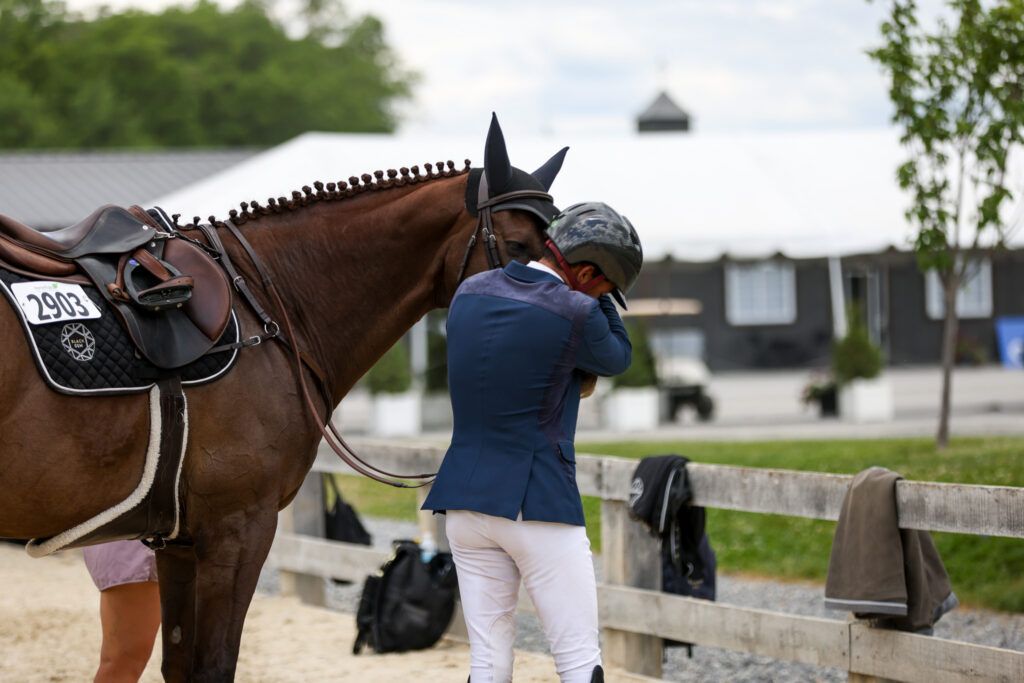
The gymnastic work that got Niven, now 14, where he is today has become part of Michel’s toolkit for every young horse that comes through his program.
“It helped in general, because I did so much stuff with him,” he says. “When I have a horse who is having trouble with something, I think, ‘Oh, Niven was having trouble with this. I can just build a similar gymnastic that I created for Niven.’ Because I was doing a gymnastic exercise with him every week, I tried so many different sets of gymnastics. It gave me more knowledge for other horses.”
When it comes to Niven’s meteoric rise through the levels, Amanda credits all the gridwork but also the freedom that comes with owning him outright.
“Niven is ours, and we decided not to sell him, which is an emotional problem on my part,” she says with a laugh. “But we’ve been able to do what we want with him. He’s gotten to do classes maybe before he was totally ready, to have the experience of going in. If Michel retires halfway through, he still got to have that experience. At the same time, he hasn’t shown that much, because we have to pay for it. But not having to sell him really takes the pressure off of needing to go in the ring and get a result.”
That patience shows in their partnership, and it makes the results that do come even more rewarding.
“Michel works very hard. We care for Niven ourselves, and he rides Niven every day, sets everything himself, measures everything, gets off, moves the jumps and moves them again,” Amanda says. “We’re four years into having Niven, and he is still even better every day. I don’t think he’s as good as he’s going to be yet.”