




 Video
VideoItalian cavalry officer Federico Caprilli (1868–1907) did not set out to revolutionize horse sports. His goal was to make cavalry more efficient. Warfare was still conducted on horseback at the turn of the 20th century, and the cavalries of the world needed a system of riding that was both efficient and easy to teach to large numbers of recruits. Before Caprilli came along, cavalrymen rode with straight legs and leaned backward when their horses jumped. Caprilli developed a new system, one where the rider allowed the horse to use his head and neck for balance.
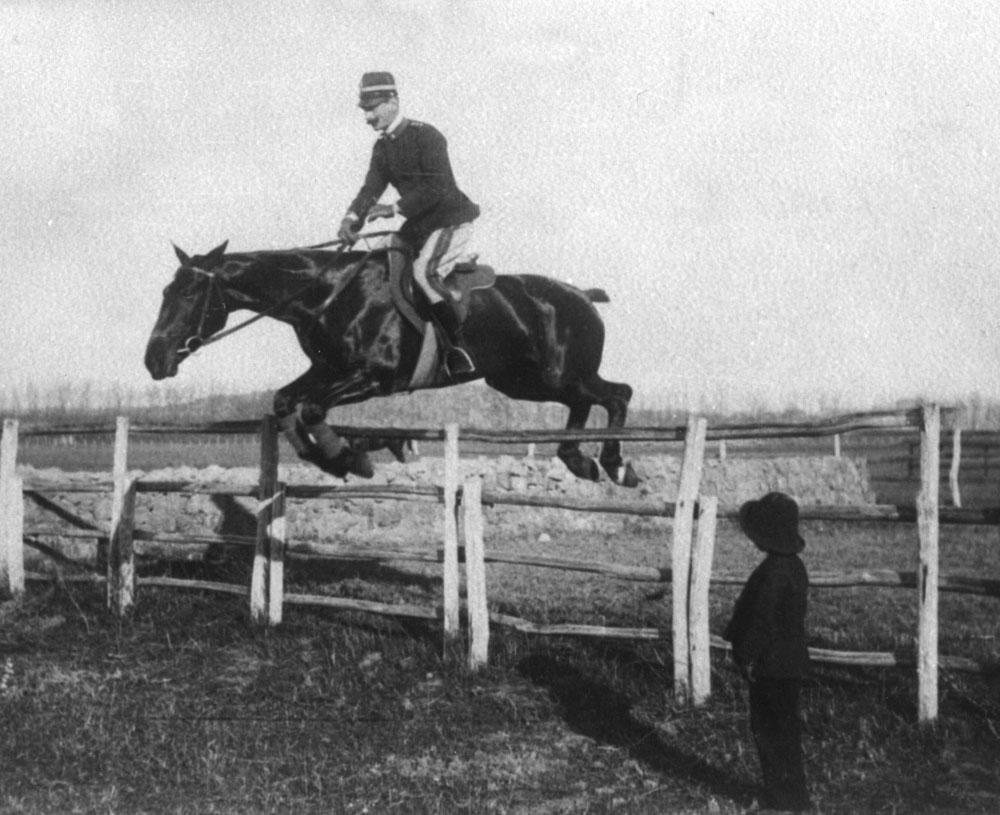
are more about the horse’s natural galloping and jumping action than they are about how riders should conform
to those motions. Reduced to ultimate simplicity, Caprilli’s system consisted of staying out of the horse’s way. In this
photo, probably taken around 1900, you can see his principles being put to a pragmatic test, jumping a tall vertical
fence line with the reins in one hand.
His poise in the saddle is a result of his lower-leg position. It is difficult to see in this photo, but you can rest assured
that Caprilli’s foot is all the way into the stirrup and his heels are down. The slight displacement of his lower
leg is more because the saddle design of the era has not caught up with Caprilli’s revolutionary change in the rider’s
position. Photos taken just a few years after this one show much more forward saddle flaps to allow for the rider’s shorter stirrups. | Courtesy, National Sporting Library & Museum
Although we now recognize his genius, at the time Caprilli was regarded as merely an upstart junior officer with radical notions about how men should ride horses. His main idea was that horses could carry the weight of soldiers more efficiently when that weight was over their shoulders, rather than their back. His student and amanuensis, Piero Santini, remarked that Caprilli’s methods were not aimed at riding for sport but rather “as a means of getting cavalry across country with the least possible strain on both men and horses.”
Italian generals of that period were no better than any others when it came to dealing with innovation, so for a time Caprilli was transferred from the Italian Cavalry School at Pinerolo to a post in southern Italy. (Apparently, southern Italy was the Italian version of Siberia at the time.)
Some biographers have suggested that Caprilli was transferred because in addition to his affinity for horses, he had an affinity for young high-society ladies. While we will never know if this is true, it would certainly not surprise us. At any rate, in 1904 his genius was finally officially recognized, and he spent his few remaining years as the chief instructor at Pinerolo, the national training center for the Italian cavalry. While riding in 1907, Caprilli suddenly lost consciousness, fell from his horse and struck his head. His death cost the horse world a true genius, but his legacy has transformed horse sports.
Caprilli, like many good horsemen, was not especially verbal. He left only a series of notes that were eventually collected into The Caprilli Papers, edited by Santini and published by J.A. Allen and Co. in 1967. In his writings, Caprilli was far more interested in the natural balance of the horse than he was in the mechanics by which a rider could allow a horse to find that natural balance. As we have all noticed at some point in our learning curves, riders who are natural geniuses in the saddle rarely make good instructors—because they do the right thing instinctively, they are not good at explaining their actions.
The description of his methods was left to his students, especially Santini, and to a Russian cavalry officer, Col. Paul Rodzianko. Rodzianko is an interesting character in his own right, having been a pupil of not only Caprilli but also of James Fillis, one of the foremost dressage riders and trainers of that era. Rodzianko’s Modern Horsemanship, published in 1937, covered much the same ground as Santini had done in his 1931 Riding Reflections.
Shorter Stirrup Leathers
The success of Caprilli’s system led to a heightened interest in its mechanics, specifically the position of the rider’s lower leg. Caprilli’s experiments with the position of the rider soon led him to the conclusion that in order for the rider to remain in balance with his horse, he would have to shorten his stirrup leathers. In his Notes, Caprilli states, “The right length of leather is therefore the first requisite of a secure seat.” (Caprilli’s emphasis)
As a result of Caprilli’s influence, in the early 1900s riders began adjusting their stirrups much as we do today. It seems obvious now that shorter stirrup leathers, viewed as radical at the time, allowed the rider to maintain his weight above his horse’s center of gravity with a corresponding improvement in the ability of the horse to go cross country easily. The new stability of the rider’s lower leg also made it possible to develop a better upper-body position.
As radical as it was for its time, however, the lower leg of that period was very different from our modern position, and I plan to examine that evolution. In brief, to achieve a lower-leg position thought to be conducive to galloping and jumping in the early 1900s, riders adjusted their stirrups so that they touched their anklebone when the foot was out of the stirrup and the leg was straight. Once the leathers had been adjusted, the rider placed his foot well into the stirrup. Caprilli stated that he wanted the “heel kept down with the foot well home in the iron …” The term “home” means that the heel of the rider’s boot is against the tread of the stirrup.
Remember, Caprilli was interested in getting men and horses safely across country, which meant security was a prime concern. The lower-leg position that developed due to his influence was a very strong and secure position, but it was fixed rather than supple. Caprilli did not view this as a defect because of his attitude toward what he referred to as “school” or dressage, as opposed to his own system of “natural” equitation. At one point in his Notes, he states that the rider’s “calves and heels should never touch the horse except by the rider’s deliberate desire.” The contrast between Caprilli’s system and present-day usage is stark because such a position is not suitable for more sophisticated communication between the rider and his horse.
Caprilli and his students firmly believed that it was sufficient for the rider to be able to guide his horse with simple aids and that any further training was not just unnecessary—it was actually detrimental. Caprilli stated that, “Manège [by which he meant “school” or dressage] and cross-country equitation are, in my opinion, antagonistic: One excludes and destroys the other.”
If one accepted the Italian system, then a lower leg that supplied stability was sufficient. However, as competitive riding became more sophisticated, the lower-leg position underwent a gradual transformation beginning in the mid-1930s. At this time another genius on horseback stepped onto the world stage: Gen. Harry D. Chamberlin, the greatest theorist the U.S. has ever produced, began to move the stirrup farther forward.
A Suppler Leg
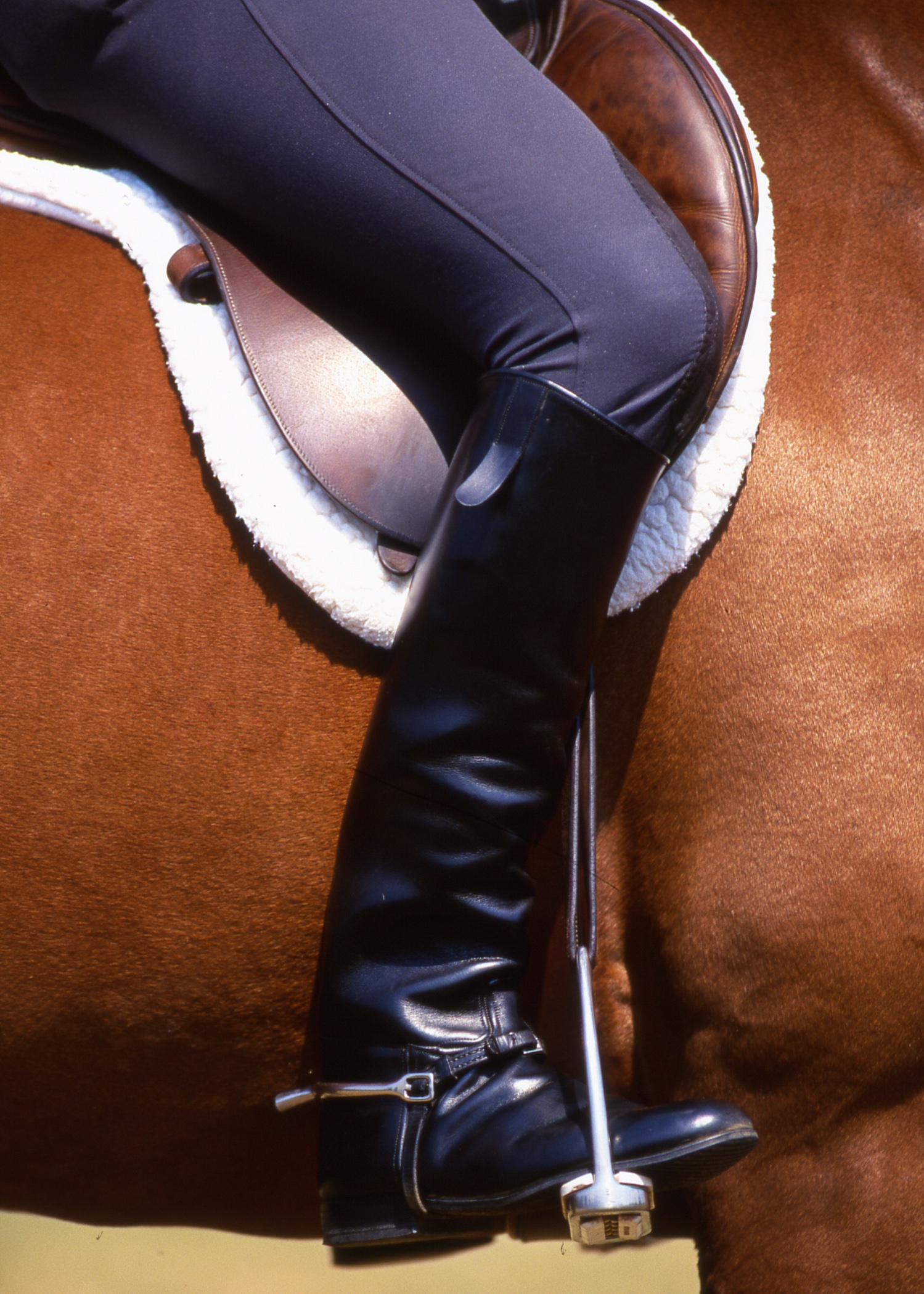
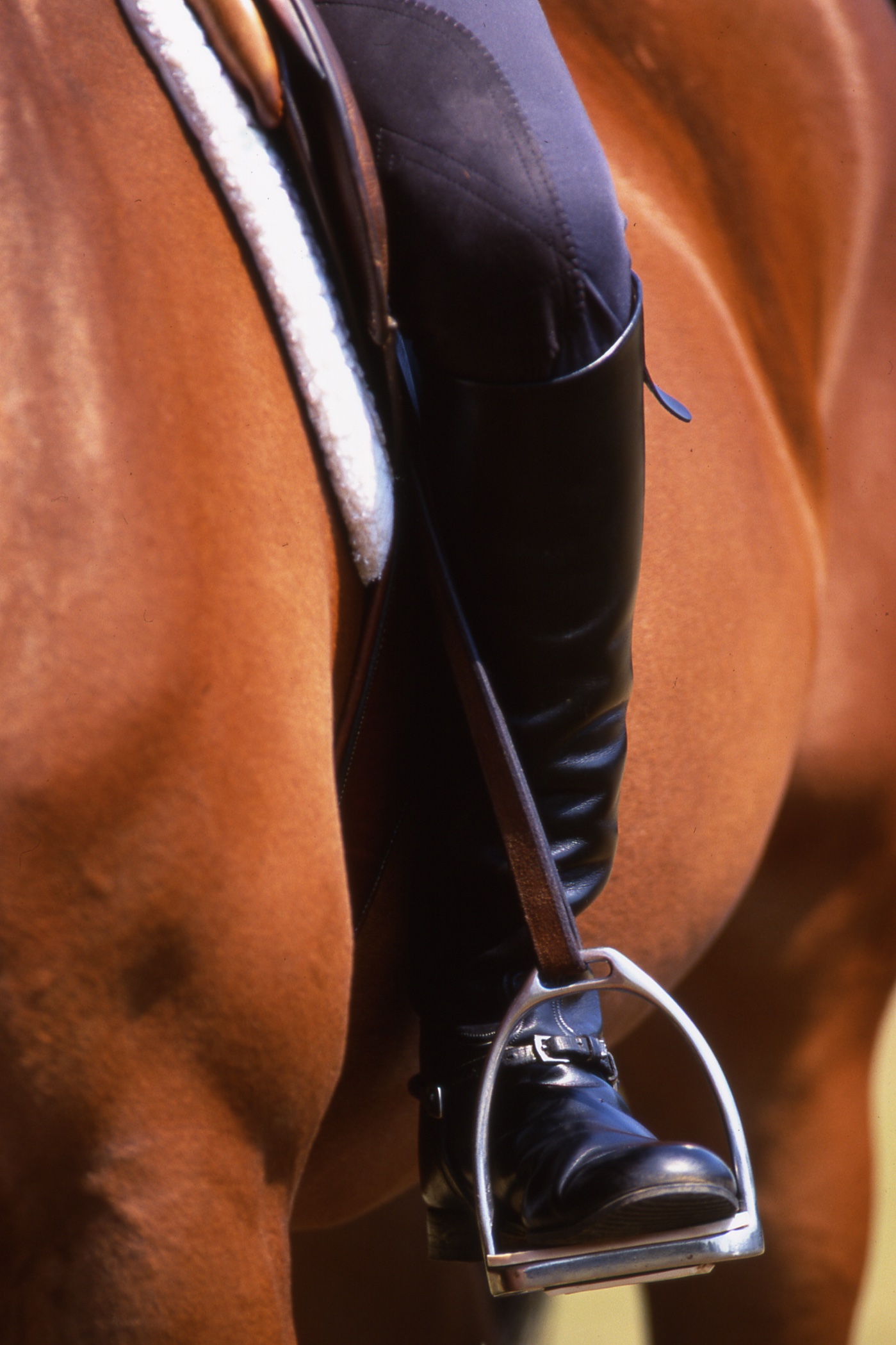
Under Chamberlin’s influence, the foot was no longer home in the stirrup; instead, the stirrup rested beneath the arch of the rider’s foot. Some textbooks of that period still require the foot to be home, but the photos of the same era show that the most successful riders have developed a more supple and sensitive lower leg, changing to a foot position that now brings the stirrup closer to the toes. The advantages gained in flexibility and communication by this small adjustment are obvious to the modern student.
In addition, Chamberlin began to bridge the gap between outdoor riding and high-school dressage. In his 1934 book, Riding and Schooling Horses, he states, “ … a well-bred horse must know how to accept pressure on the bit … .” This quote illustrates that Chamberlin was moving beyond the Italian system and developing a program that incorporated simple dressage work into the overall training of the horse. Throughout his writings, he began to depart from the Italian theorists who maintained that the horse should be allowed the greatest possible freedom. Chamberlin’s genius lies in his ability to promote the synthesis of dressage and cross-country riding. My earliest riding instruction was from students of Chamberlin. All of those men left me in no doubt that my horses must be obedient on the flat to be efficient over fences.
As horse sports became ever more competitive, the lower leg continued to evolve. Note, however, that while the details of the lower leg evolved, the stirrup leather has remained vertical for over a century. Caprilli and Chamberlin were geniuses, but they could not repeal the laws of physics.
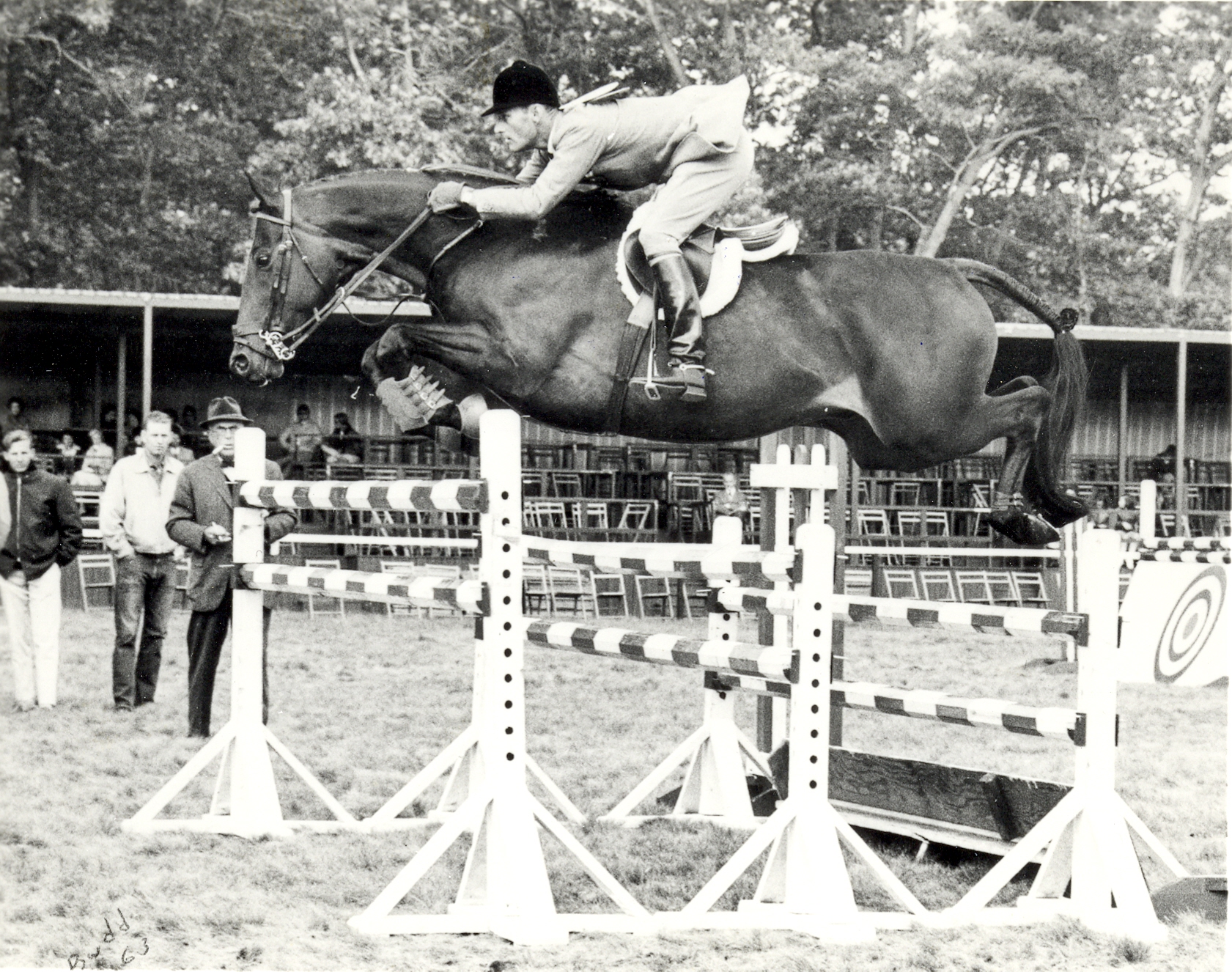
By 1956, U.S. Show-Jumping Coach Bert de Némethy was meticulous about the placement of the foot in the stirrup despite the fact that it was not the same placement that earlier generations of riders would have been comfortable with. The increased competitive demands for control of the horse’s speed and length of stride required a very supple, sophisticated lower-leg position. About this time the lower leg assumed the position we would recognize today: stirrup leathers adjusted to produce a 90-degree angle behind the rider’s knee when the rider is seated, the ball of the foot on the tread of the stirrup, the little toe against the outside branch of the stirrup with the stirrup at right angles to the girth and the heels down. When seated, the rider maintains leg contact with the horse’s body from above the knee to as far down as the conformation of the horse and rider will allow. With this contact, the rider has a wide range of leg aids at his disposal, from subtle pressure to insistent use of the heel and spur.
Does all of this sound familiar to you? I hope so, because this lower-leg position is the state of the art.
About Jim Wofford
Longtime Practical Horseman columnist Jim Wofford competed in three Olympic Games and two World Championships. He also won the U.S. National Championship five times. Additionally he was also a highly respected coach. For decades beginning in 1978, he had at least one student on every U.S. Olympic, World Championship and Pan American team. He passed away February 2, 2023.
This article originally appeared in the December 2015 issue of Practical Horseman.