




 Video
Many of my cross-country schooling sessions start with some of the most basic elements: water, banks and ditches. Understanding these types of questions is a fundamental step in an event horse’s education, and even my Advanced horses typically start off by getting their feet wet or walking up or down a small bank. This ensures my horses start their schooling relaxed, and it slows their brain down so they can understand the footwork of these obstacles. A relaxed horse is listening, more responsive to the aids and more confident. Once it’s clear my horse is relaxed and confident, I’ll build in more jumps and coursework depending on what each horse needs to practice.
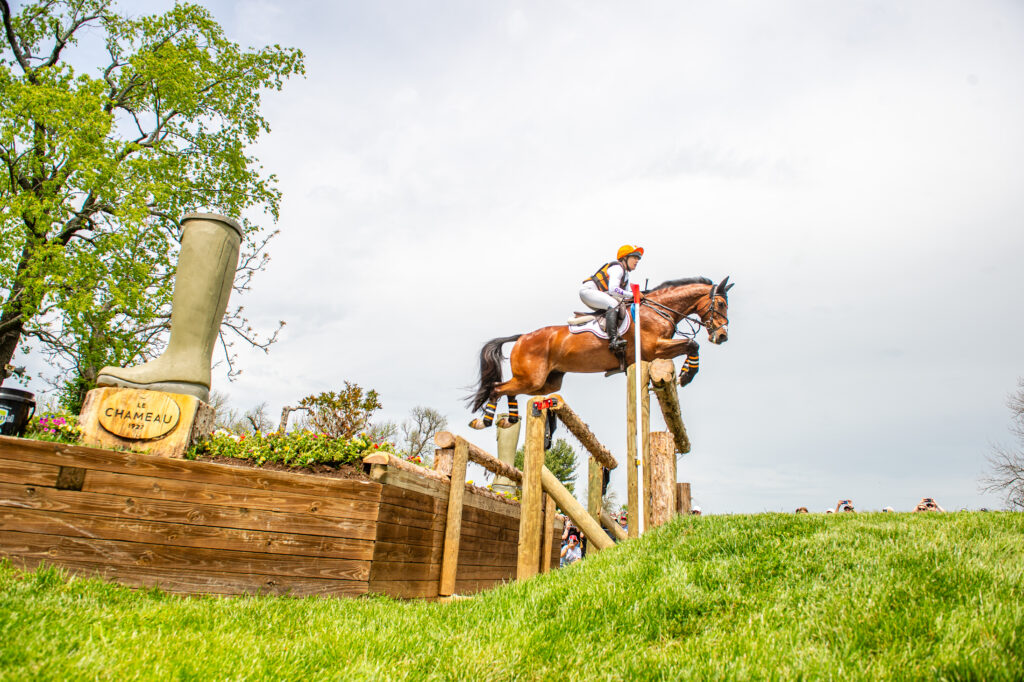
In this article, I share 13 tips for creating happy, relaxed and confident horses who will be successful on the cross-country course, whether you’re schooling or competing.
A Relaxed Athlete Performs Better
A relaxed athlete performs better, no matter the age or level. If your horse is relaxed, he’s going to be more successful. It’s your responsibility to start the horse off that way. I like to start by simply walking my horses through the water, in and out, or up and down a small bank. I make it easy, fun and simple for them. For horses who start off excitable, transitions are your friend, just as they are in the ring!
Relaxation applies to you as the rider, too. Of course you might get nervous when you’re cross-country schooling or competing. Who doesn’t? Sometimes those nerves translate to trying to ride faster or defensively to compensate for not feeling very brave, and you end up with too much speed or hand interference, which does the opposite of keeping the horse relaxed. The good thing is you can teach yourself to be calm. I rely heavily on breathing exercises and meditation before important rides. This helps me focus, slow my mind down, and relax. I can’t recommend this enough to help you relax and face any nerves you might be feeling.
Make Sure He’s Focused
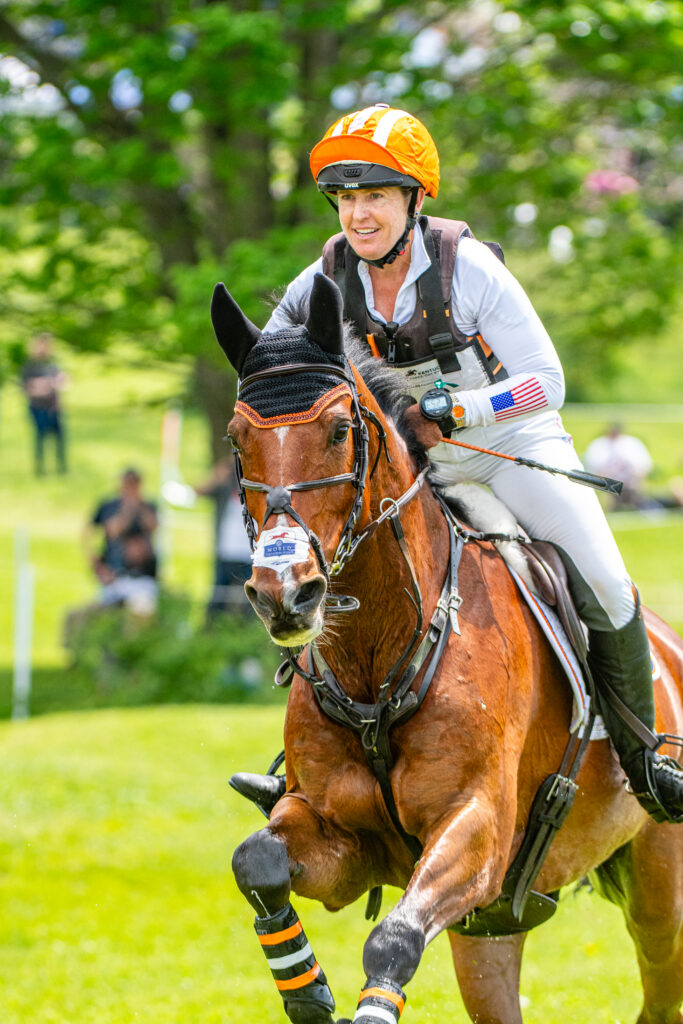
Now it’s time to get your horse to focus. Watch your horse’s ears: are they frozen forward? Or do they flick back to listen to you? Are his eyeballs wide and does he seem distracted by everything? You want his attention on the task at hand. Transitions are my top recommendation for accomplishing this as you warm up, as is lateral work like leg-yield and shoulder-in. These exercises tune the horse in to your aids (kind of like their own form of meditation!). When you begin jumping, start with something small and simple to let your horse know what the job is. Don’t be afraid to go back to transitions and lateral work if you are struggling to get your horse’s attention once you begin jumping.
Intentions Are Important
Horses go the way they’re ridden. Be clear about where you’re going and what you’re asking. It matters. Your horse shouldn’t wonder what you’re asking him to do. The same goes for you. You’ll perform better if you know the plan. If you’re unsure of the plan, then you become hesitant and that’s when it gets vague for the horse.
Know Your Responsibilities
Riders are responsible for many things, but I believe the main priorities are:
1. Maintaining your headspace – It’s never a recipe for success to bring a bad headspace to your ride—that’s when things can spiral and hard work can be undone. The truth is, emotions don’t really belong in riding. They happen, of course, but it’s our job to manage them and allow ourselves to be present for our horses.
2. Setting and keeping a rhythm – Horses look to us for instructions, and the instructions we give them should be clear. Establishing a rhythm allows a horse to stay in balance.
3. Steering – As the rider, you know where to go. Your horse doesn’t. It is up to you to be his leader and make sure you are being clear with your aids so he understands the line of travel.
4. Holding your position – A stable, strong position gives both you and your horse confidence, and it matters a lot for safety.
Do It Slowly
To build your horse’s confidence, approach cross-country obstacles slowly and steadily. It doesn’t make any sense to gallop toward the water to see if your horse is brave, because surprise is never a good thing and you don’t want to scare a flight animal.
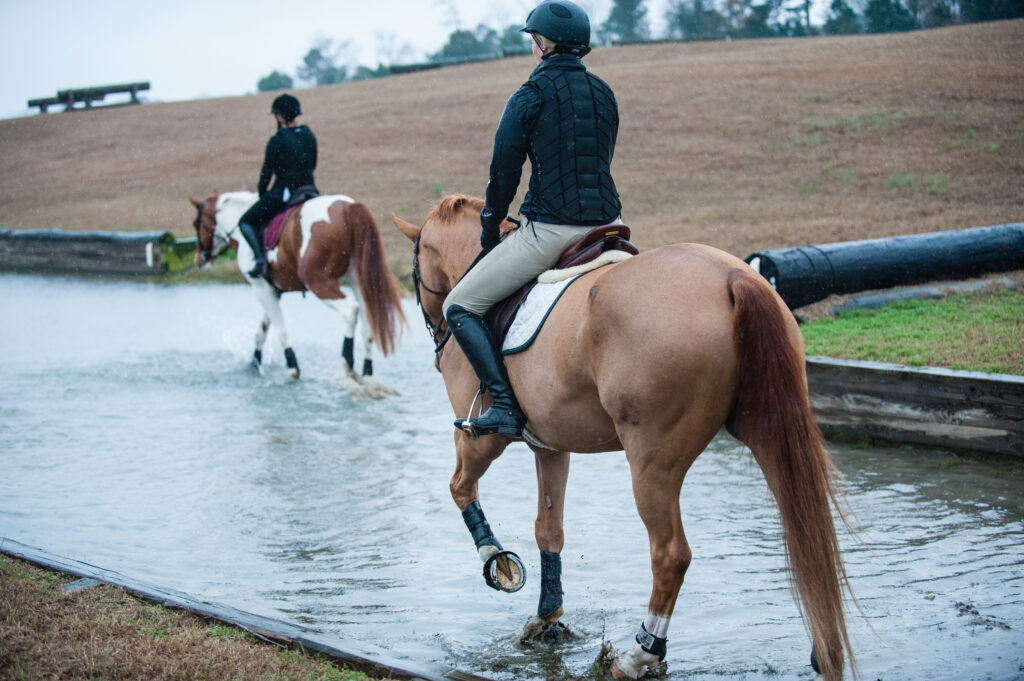
Whether he’s a young horse or advanced, your horse should be able to walk in and out of the water, walk up and down banks, and walk across ditches. If he can do it slowly and completely relaxed like a Western pleasure horse, then he can do it more confidently as you increase the rate of speed. And if your horse can’t do it slowly and easily, then it’s going to be hit or miss whether he can do it fast. At that point, it’s just luck, and I like to make my own luck by doing the work.
Repetition Is the Mother of All Skills
Whether you’re practicing water, banks or ditches, you have to show the horse one million times that it’s all good, and that they can do this. Go through the water, up and down the bank, or over the ditch, then turn around, and do it again. Repeat it over and over until it becomes boring.
This doesn’t mean do it until the horse can’t think anymore, but rather it’s like any acquired skill. Just keep practicing, without pressure, and eventually you will improve and he will learn he doesn’t have to try so hard. Keep coming until he thinks it’s the silliest, easiest thing he’s ever done and is super confident.
Teach Him the Footwork
Banks are a different physical effort for a horse than a jump. A lot of horses don’t know how to walk banks slowly, which means they don’t know their footwork. You don’t want your horse to leap off a bank, so you have to show him how to not do that with repetition.
Show your horse it’s no big deal and he can do it relaxed and easy. Start by walking the up bank with long reins, like you’re on a hack. Your job is to steer, keep your leg on and your eyes up. Try not to change your position or your attitude at all because it will encourage your horse to try too hard. It’s no fuss, no muss. His job is to step up with no stress. When he walks up the bank, make a big deal out of him. When the up bank is going well, walk the down bank using the same method.
The Ditch Is Just a Canter Stride
The ditch is one of the easiest cross-country obstacles because there’s no effort to it. Banks are a different physical effort, and horses have to learn how to do it. Water has drag, and they have to put in more effort. But a ditch is just a canter stride.
So why are horses weird about ditches? Usually it’s because the riders are weird about ditches. When horses are learning, they might look at the ditch, but others don’t care. And certainly when they’re established, they don’t care at all.
When schooling the ditch, start by asking your horse to walk with purpose and step over it. Turn around and come back over it from the other direction. Keep your legs on with soft reins and your eyes on a point in the distance. Stay back and behind the motion with your upper body, and keep your horse’s feet moving until he steps over the ditch. As he gains confidence and eagerness, it’s OK to allow him to trot or canter to the ditch, however if you sense that the additional speed is an anxiety response, don’t be afraid to take it back down to a walk for a few tries.
Use His Friends
If your horse is nervous about the water, bank, or ditch, let him follow a confident horse. This creates a positive experience for the nervous horse because horses are herd animals and rely on each other for support.
Once the horse has followed a friend over successfully once or twice, ask him to do it on his own. You can place his friend on the landing side for a time or two, but eventually the emotional support should be removed.
Get Comfortable With Terrain
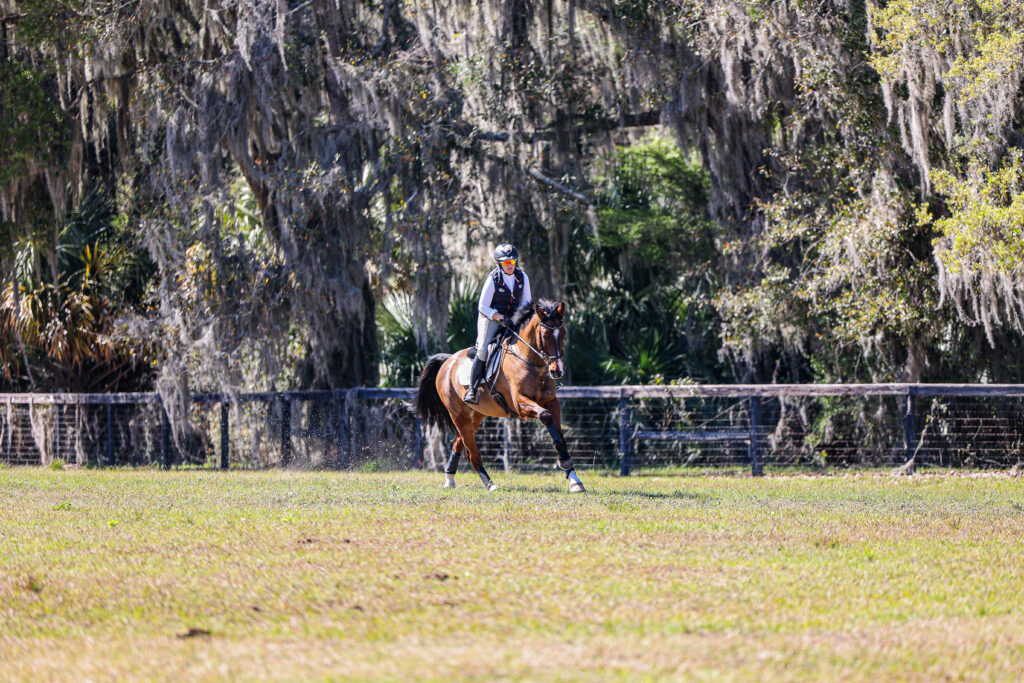
It’s important to practice riding on terrain, even if you aren’t jumping. This applies at the walk, trot and canter. Practicing getting comfortable over varying terrain and surfaces is a big key to building confidence and capability. Eventually, you’ll learn how the terrain affects your horse specifically, and how you can adjust to their changes in balance.
Give Your Horse Information That Makes Sense
If you feel your horse add an extra stride in a combination, there’s nothing wrong with that. The information that makes sense to your horse is to tell him to go forward. If your horse does two strides in a one-stride combination, the only answer is land, close your leg and say, “Hey, stay in front of me.” And the opposite is true. If he puts a one stride in a two-stride combination, the only answer would be, “Whoa, easy on landing.”
Respect Your Horse
Horses respond really well to positive energy. You don’t have to be perfect at any point in time, but you do have to ride your horse positively, knowing he is trying his best and takes pride in his job, just like you. If your horse is worried or does something unexpected, remember he’s a flight animal, and he’s allowed to get weird. But don’t get weird with him. Assure him that everything is OK. Focus on him—what makes sense to him and what he needs.
Know When to Stop
Take into account what is the best for your horse and how much jumping he should do. He may be able to do more, but maybe it’s not what he needs on that particular day. If you always do right by your horse and put him first, you’ll have a solid partnership and connection with him.
For More:
Practical Horseman+ members can watch training videos with Sharon White. To subscribe to Practical Horseman+, click here.
To read more articles from White, click here.
About Sharon White
Sharon White is an international five-star eventer, trainer and Level 4 U.S. Eventing Association ECP Certified Instructor based at Last Frontier Farm in Summit Point, West Virginia. White has more than 10 starts at the Kentucky Three-Day Event with five different horses. She has also traveled overseas to contest CCI5* events at Lühumulen and Les Etoiles de Pau, as well as CCI4* events at Boekelo and Hartpury. She earned a team silver medal at the 2023 Pan American Games with Claus 63. Most recently, White won the second edition of the 2026 US Equestrian Open of Eventing with Claus 63.