




 Video
VideoAriel Grald and Obalix had no room for error as the final pair to enter the Kentucky Horse Park’s Rolex Stadium on Thursday evening, Aug. 27 at the 2026 USEA American Eventing Championships presented by Nutrena Feeds (AEC). They were contesting their show jumping round for the USEA Intermediate Open Championship with a lead of six-tenths of a point. Grald and the 8-year-old Oldenburg (Ogano x Bilitis B VH Juxschot Z, by Berlioz) gelding owned by Annie Eldridge scored 29.6 in their dressage test on Aug. 25 and added 1.2 cross-country time penalties to their score on Aug. 26. The pair delivered under pressure to have a double-clear round and secure the champion title with a final score of 30.8.
We caught up with Grald to discuss the top moments from the AEC, Obalix’s training routine at home and more about “Dempsey.”
A Successful Week at the AEC
PH: Tell us a little bit about your week with Obalix.
AG: I really can’t say enough good things about the horse. It’s funny; I actually feel a lot of pressure riding him, not because he’s not good, but because I know that if it doesn’t go well, that’s all on me. He’s still pretty young. This is his first season at Intermediate and three-star, but he’s just a really special horse. I was very happy with him in the dressage. I think he put in about as good of a test as he can at the moment. There’s a lot more in there, but we’re just sort of building strength.
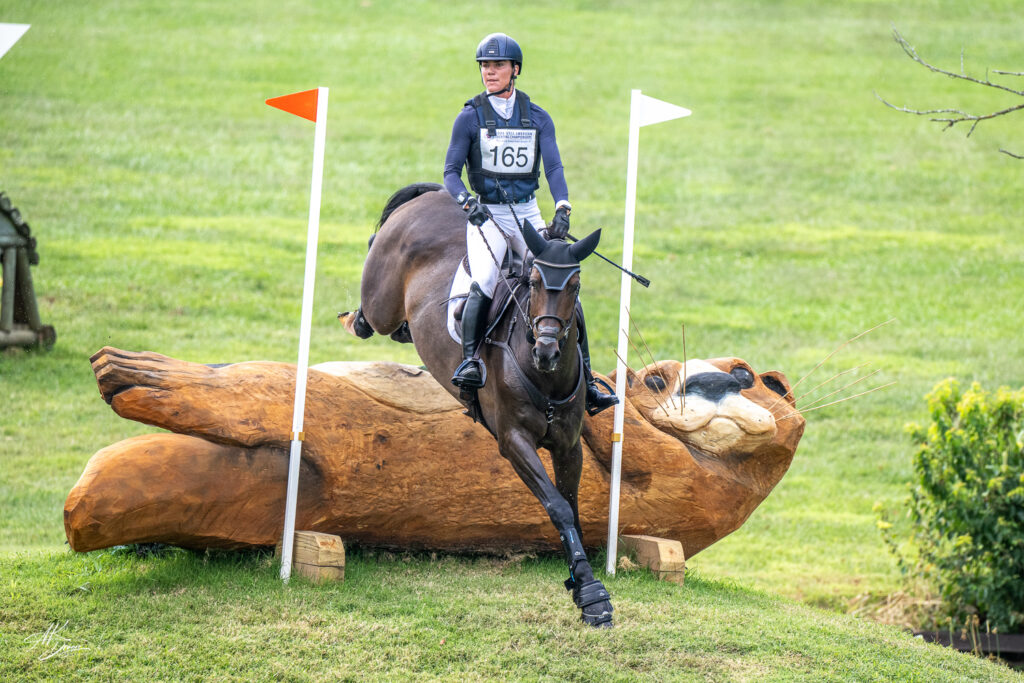
The goal for cross country was to have a good round, but I did want to go quick. He needs to work on his gallop, and he’s aimed for another three-star long this fall. So the point was to come run up some hills and see where his fitness is. And he answered every question. He made it feel really easy. Again, it’s on me to mess it up. As long as I ride well, he’s perfect.
Then, show jumping’s been a little bit of his [weakest] phase. He tries really hard, but he just gets a little distracted. He’s a little green sometimes, so we’ve been working at that this summer and just spent a little bit of time show jumping at [HITS] Culpeper, and that was really helpful. So I felt pretty good. He jumped great in the warm-up and again; it’s just on me to pilot him reasonably well and let him do the rest. I was really happy with him.
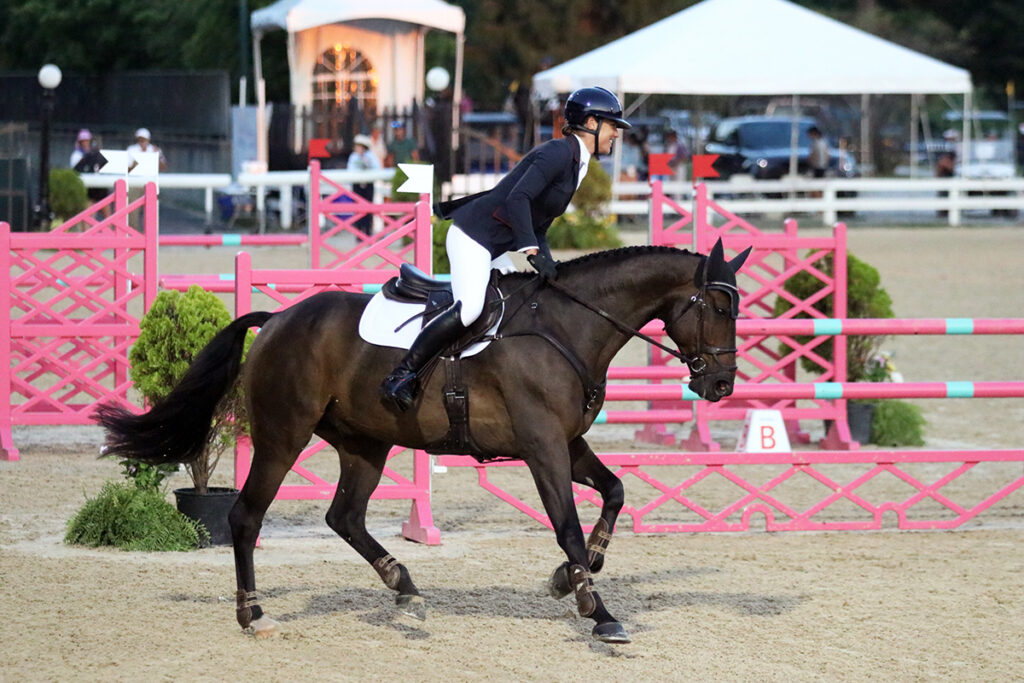
PH: With jumping here under the lights and culminating with the win, what does it mean to you to come here to the AEC?
AG: I’ll be honest, I came with the goal of being as competitive as possible and knowing that if he probably put in three good phases, you know, we’d at least be somewhat near the top. I was hoping. To be able to put three good phases in, there’s still room improvement for each of them that we need to find sort of those next levels.
But I’m just so happy with the horse. It went as well as I could ask and expect of him at this point and to be able to start to find that consistency with him because that’s what it’s going to take for him to be a top horse is that you can come out time and time again and put in three good phases. I’m just really proud of the horse, and I give all credit to him.
Getting to Know Obalix
PH: What’s your background with this horse?
AG: Funny story. I’ll give Annie Eldridge, his owner, all the credit. We bought him late in his 5-year-old year. I had actually been over to Europe looking at horses and was on my way back. She was like, “Oh, there’s this horse you’ve got to see in Virginia.” And I was like, “Eh, he’s kind of ugly.” He was just kind of fat. Like he’s just this round, pudgy little five-year-old. And I was like, “Eh, I don’t know about that.” She’s like, “No, you have to go see him”. I sort of reluctantly stopped in Virginia on the way home to look at him. And I sat on him for five seconds. I was like, “Yep, done. Take him.” She was right, so I’ll give her the credit. Kelli Temple had imported him.
We bought him late in his 5-year-old year, and then he’s really trucked right along. He got to a two-star by his 6-year-old year. Then unfortunately, last year wasn’t quite what he needed. He was in the lead at Bromont, and I crashed on my other horse, so he didn’t finish, which was a disappointment. Last year, it started off really well for him, but it wasn’t quite what he needed as far as development. But a little more time never hurts a horse, ever.
He’s just come back really strong this year. I got him back out a couple times at the end of last year, but just unfortunately missing three months at that 7-year-old stage is sort of crucial. But he’s catching back up, and I’m really happy with where he’s at.
PH: Do you think he has what it takes to be a five-star horse?
AG: He does. I think so far he’s showing me he’s got it all. He’s quite different than Simon (her retired five-star and 2022 World Championship mount Leamore Master Plan), but I would say he has a lot of the same personality traits, so he always makes me laugh. Obalix is a really playful, like a very cheeky, goofy horse. He’s constantly playing games, and he’s just a character, and he’s very, very confident in himself. He tries really hard. He’s clever; he’s one of the smartest horses I’ve ever ridden. And he’s got the talent. So fingers crossed!
PH: With training him at home, are there any specific exercises you like to work on with him, either on flat or jumping?
AG: On the flat, he’s actually gotten pretty broke at this point, so I do a bit harder stuff with him. He does a lot of advanced lateral work. He’s actively schooling the Advanced tests and stuff like that. He likes a challenge. The more you give him to do, the better. For the flat, you’re just constantly trying to get him supple in his body because he’s like riding a little bouncy ball. We’re always trying to get him just a little bit looser, so lots of lateral work and just sort of trying to open him up a bit.
Then in the jumping, I’ve actually finally learned to do a little bit less with him. We don’t practice a ton of big courses. We do shorter sets of exercises. I’ve always ridden a bit with Will Faudree, but he’s been particularly helpful with me in show jumping this year. We’ve been working with this horse, because although Obalix is a very good jumper, I had some rails on him back in the spring, and I was kind of struggling to figure out quite what was missing. Will has really helped the rideability.
And again, getting him to soften and use his body a little bit more and not just kind of ping pong around, just power jumping. Actually, having a little more athleticism in his body and a little bit more suppleness. So at this point, I don’t jump a ton of jumps in a jump school. It’s more about the flat work over fences. I know that sounds kind of boring, but it really is back to the basics. If you get him good in his body, and that’s where Will has really helped me is getting the canter and the turns because the jumping is fine. It’s getting his body better so that you arrive to the jump in the right balance and the right relaxation and suppleness. That’s really helped his show jumping a lot.
PH: If Obalix was a person, what kind of person would he be?
AG: I feel like he would be like a neurosurgeon or something like that. He would do something pretty smart. Like, he’d definitely be into surgery, because he’s a little bit cocky and like a little bit of a jock, so he’d have to have that confidence, but he’d do something highly intelligent.
Being in the Zone
PH: Is there a phrase that you tell yourself before going into the ring or heading out of the start box?
AG: Something I tell myself—and this is true in any pressure situation having previously done five stars and a world championship—I always tell myself nothing else matters except me riding well, and me and this horse. I have this ability to let everything go quiet, and when I’m riding, I don’t see people or anything, and I don’t hear anything other than just me and the horse. I think it’s about my ability to really be in the zone where I tell myself nothing else matters, and it’s just you and this horse. That kind of helps me tune whatever else is going on around me and just tune that out and focus on the horse.
PH: Is there something you tell your students before they go into the ring?
AG: Breathe, ride smart, half-halt, kick. No, but I think that one thing is to ride in the moment, and that’s probably a better way of saying what I just rambled on about. What I tell students a lot is just be in the moment. Don’t think about what just happened, don’t think about what’s going to happen five jumps from now. Being in the moment and being in the same space as your horse, not just physically, obviously, but mentally, that you and your horse are moving along at the same speed—that’s really important.