




 Video
VideoDoes your horse tend to drift in one direction over a jump or coming down centerline? Or maybe he resists or struggles with lateral work in one direction? If so, it might be time to assess your horse physically. One of the most overlooked factors in diminished performance is simple muscle tightness. When a muscle is tight, it creates resistance to specific motions, and the greater the muscle tightness, the greater the resistance.
Drifting in one direction is a common problem I encounter with horses in all disciplines and levels. When a client raises concerns about this issue, I typically look at the longissimus costarum—a small, narrow, outer back muscle adjacent to the outer edge of the large back muscle called the longissimus dorsi.
The longissimus costarum extends across the lateral sides of all the ribs and connects to the thick fascia in the lower back and to the forward end that runs under the scapula (shoulder blade) and attaches to the last cervical vertebrae. When trying to find it with your fingers, it feels like a 1-inch ridge below the longissimus dorsi. We can only assess the muscle by hand from the last rib to right behind the scapula because it attaches underneath the scapula and out of reach.
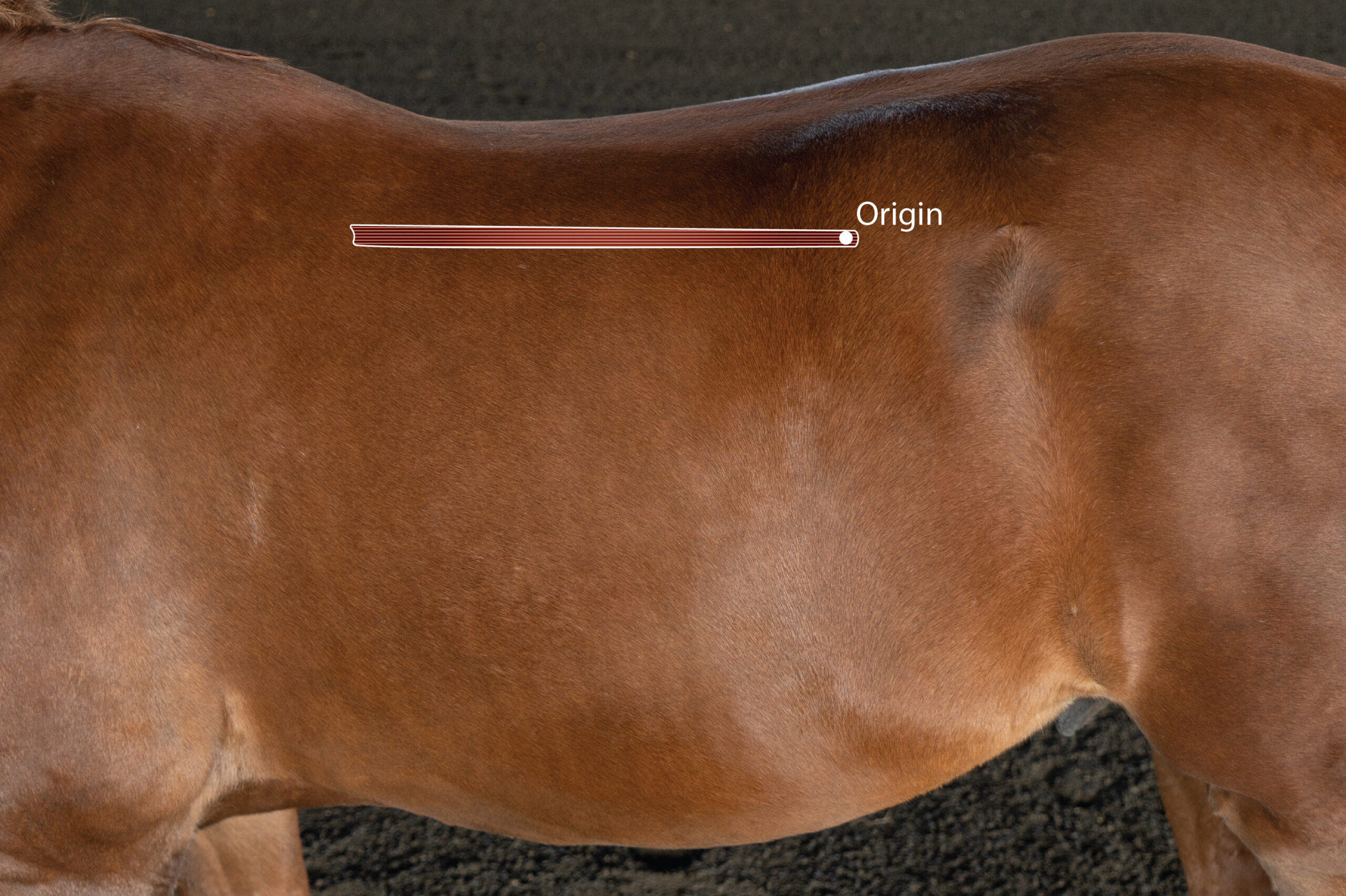
This muscle works to assist the larger back muscle in extending the spine and also helps in expiration. Individually, the muscle bends and flexes a horse’s spine and body laterally in the direction of the muscle contraction. For example, when the left side of the longissimus costarum contracts, it bends the horse’s body toward the left side.
When the muscle is tight, it can still contract without issue but when it attempts to release, or let go, there is resistance to the opposite motion. For example, if the longissimus costarum is tight on the left side, it doesn’t release properly to allow the body to bend to the right and vice versa. Essentially, the tighter the muscle is, the harder it is to release and resistance to the required motion builds. Horses will move or drift toward the tightness, so if you feel your horse drifting left, you can almost guarantee that the longissimus costarum on the left side is tight.
The Importance of Keeping Muscles Loose
If you think about the energetics of motion, it’s like a wave through a horse’s body. The motion starts at the base of the hind leg and ends at the poll. Any tight muscles along the body will interrupt the wave or flow of forward motion, and if that interruption is due to a tight longissimus costarum, then other muscles will begin to compensate.
You can also compare a horse’s motion to the synchronization of pistons in an engine. Like pistons, the muscles must work in perfect timing—contract, release, contract, release. When the muscles are properly synchronized, you get balance, coordination, stamina and, ultimately, safety. The easier your horse can move, the greater his performance, so it’s critically important to keep his entire body loose. If you interrupt the timing with a tight muscle, you interrupt the synchronization and the forward movement of the horse.
Muscles are made of tiny fibers with adequate space between each one, like the fibers in a high-quality cotton shirt. When muscle fibers are tight, they lie very close together, preventing adequate blood flow, which carries oxygen into the muscle. A horse builds resistance when those fibers are close together, thus he is working against himself from the very first stride. The degree of resistance determines how well he can perform and how much he can do before he tires, and it can set a horse up for injury.
Assessing Tightness in the Longissimus Costarum
I assess any type of muscle tightness in three different ways: visually, auditorily and kinesthetically. To visually assess muscle tightness, I have a handler walk the horse in straight line away from me for about 75 feet then turn around and walk back. I pay careful attention to whether his body is straight or if he drifts left or right. You can best see the muscle functioning at the walk because the slower a horse moves, the more muscles he has to use.
Next, I simply listen to the horse’s trainer or rider or both. For example, a dressage rider might say she didn’t score well coming down the center line or during shoulder-in on her test because her horse kept drifting into her left leg. This gives me information on how the horse is moving under saddle.
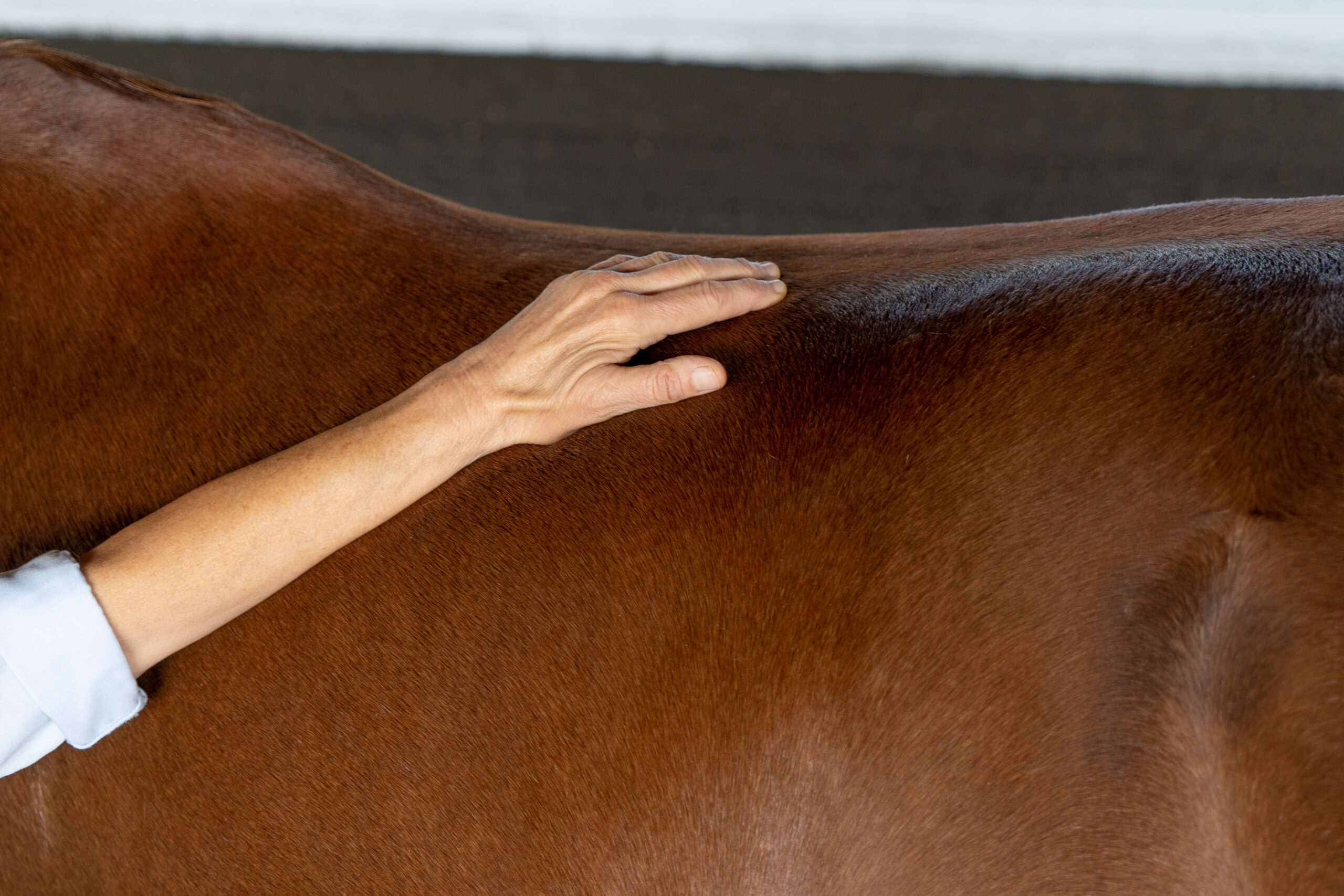
Lastly, I use a kinesthetic assessment with my hands, which you can do too. If you suspect the longissimus costarum is tight on one side, locate the last rib and feel if there’s a tiny knot attached there. Follow the inch-wide longissimus costarum from the last rib as it runs parallel to and connects with the larger back muscle (longissimus dorsi) and continue following it to behind the shoulder blade. If the longissimus costarum is really tight, it’ll snap underneath your fingers. In the saddle, if you feel like your horse is more resistant to bending in one direction or tends to drift one way or the other, he likely has tightness in the longissimus costarum
Causes of Longissimus Costarum Tightness
There are a few possible causes of tightness in the longissimus costarum. A common contributing factor is repetition of motion. When horses are harder to bend in one direction, many riders work them more in that direction in an attempt to improve the bend. Unfortunately, the opposite actually happens, and this makes the tightness worse. For example, I had a client who was a Grand Prix dressage rider, and she repeatedly practiced passage when she was struggling with the movement. Drilling the movement was setting her horse up for muscle tightness.
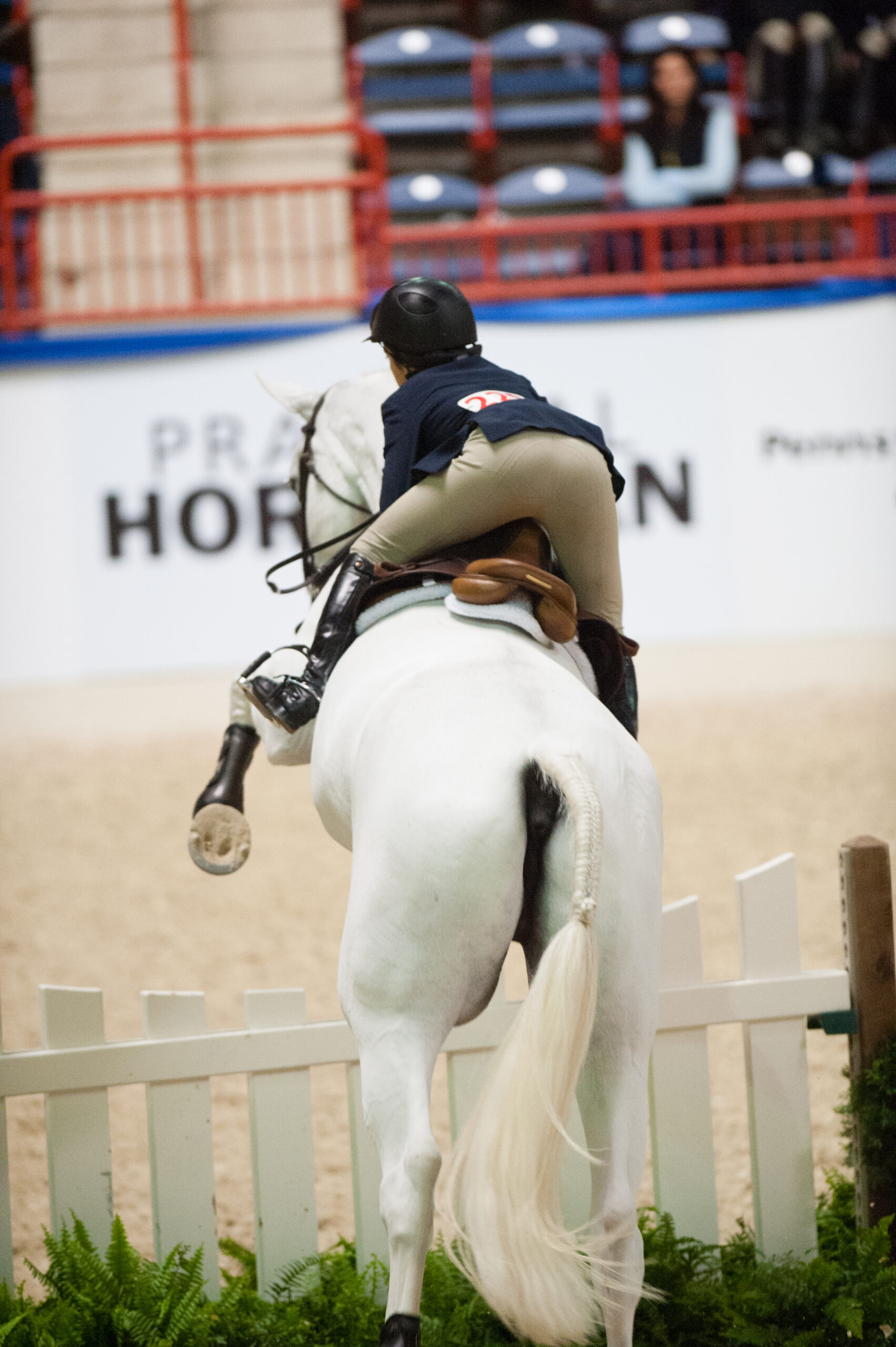
Horses can also experience longissimus costarum tightness after getting cast in a stall. We don’t always know when a horse has been cast, but muscle tightness may be one indication. When a horse is cast, he pushes off the wall to get unstuck, which can lead to muscle tightness on the opposite side of his body. A tight longissimus dorsi may produce compensatory tightness in the longissimus costarum.
An unbalanced rider or saddle can also cause longissimus costarum tightness. For example, let’s say a rider constantly sits to the right. The horse will always strive for balance, so he may tighten the muscles on his left side to better balance his back and counter what’s happening on the right side.
Lastly, an underlying issue is another possible cause of longissimus costarum tightness. Horses might drift in one direction to limit weight or take some of their weight off the opposite side due to an injury or soundness issue. I had a client whose horse drifted significantly to the left. He had lameness in the right front coffin bone that improved with a joint injection. He may have been drifting left to take partial weight off the right side.
Correcting the Tightness in the Longissimus Costarum
To release tightness in the longissimus costarum, there are three techniques that the Wilson Meagher Method of Equine Sportsmassage uses to relieve muscle tightness.
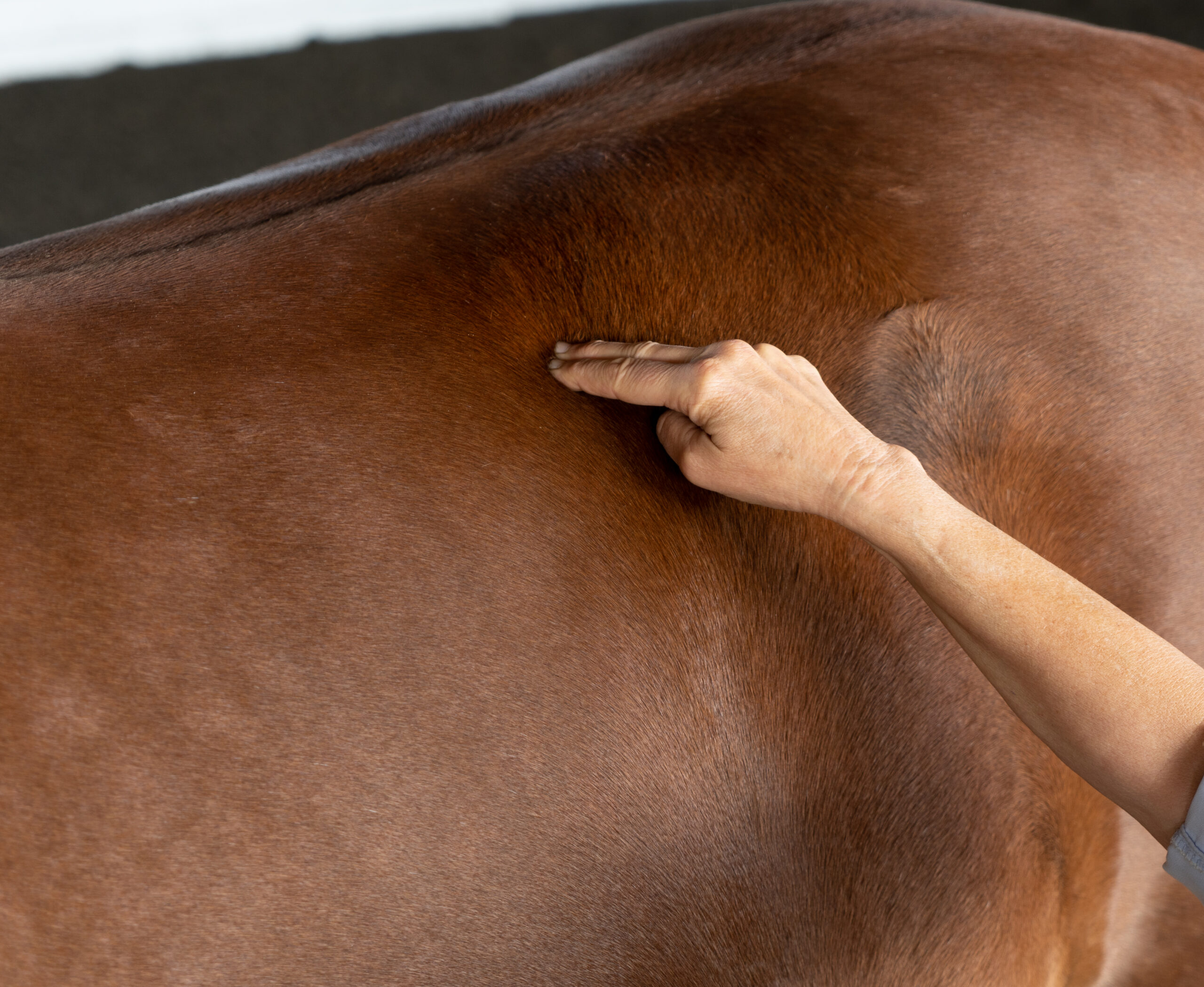
One is direct pressure, or simply putting pressure on a specific spot of knotted tissue. Identify your horse’s last rib and use two fingers to locate knotted tissue which can feel like the size of a dime or grape and apply moderate direct pressure to it. If your horse moves away from the pressure or shifts his weight toward you, the pressure is likely too much and uncomfortable for him. In this case, release your fingers, reapply them with lighter pressure and hold the pressure for five to 10 seconds. This will signal the brain to send more blood to soften the tissue and reduce tightness. After applying the direct pressure to the knotted tissue, you may locate the one-inch muscle that feels like a ridge all the way to the back of the shoulder blade.
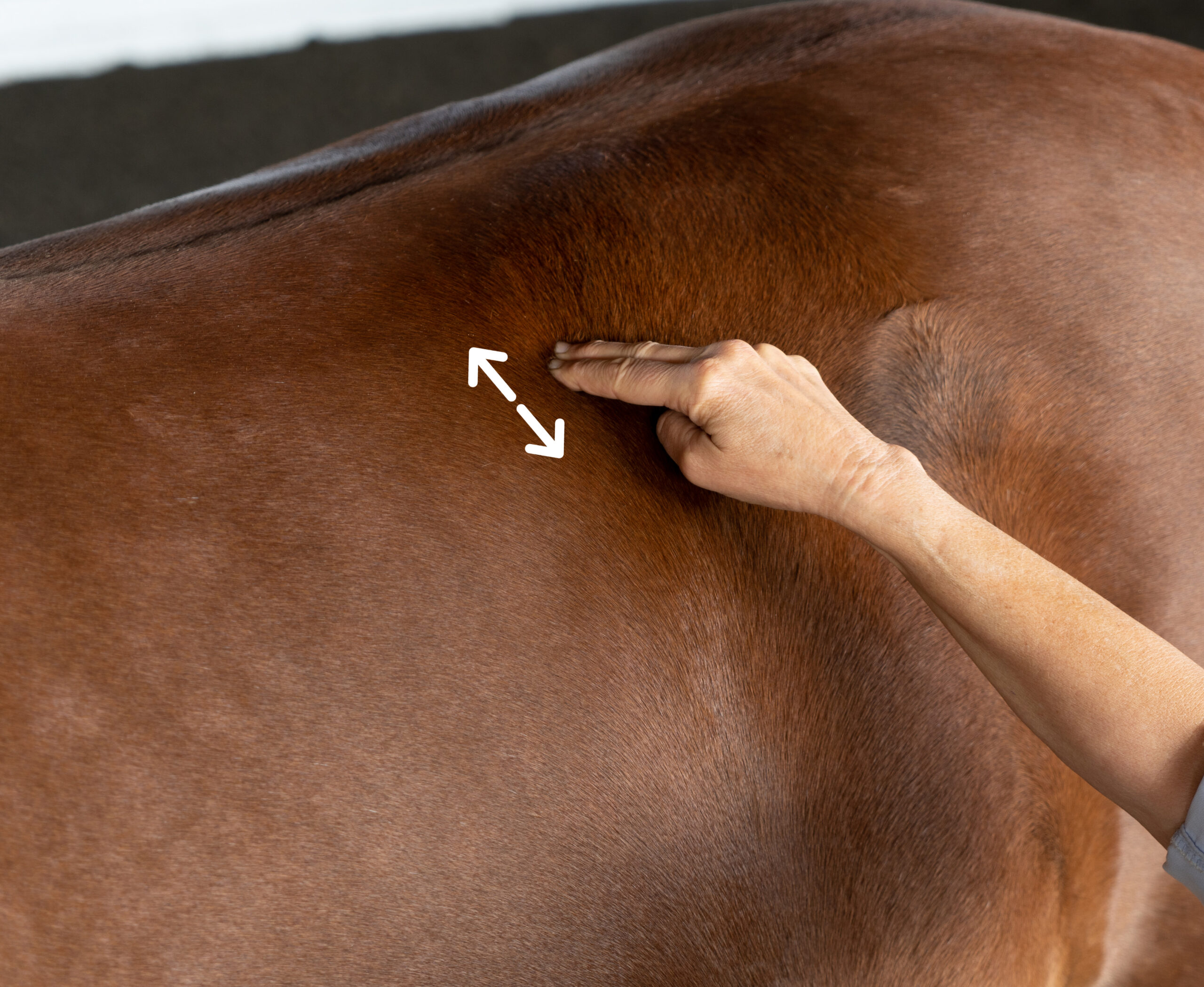
The next technique is cross-fiber friction, which helps to loosen and separate the muscle fibers. Without taking your fingers off, cross the muscle fibers of the knotted tissue by moving the pressure as if it was crossing the grain of wood. Since the longissimus costarum is horizontal, cross the fibers vertically back and forth for about 10 seconds. Then, remove your fingers for a moment and feel if the tissue has changed at all or softened. If it has changed, stop the cross-fiber friction. If the muscle hasn’t changed, repeat the same sequence of direct pressure and cross-fiber friction techniques again.
Once the muscle has changed, I then use a compression technique along the length of the longissimus costarum to further separate the fibers, allowing for more blood to enter the muscle and to help it release. To do this, place your fingers on the ridge by the last rib and compress in with your fingertips or use the heel of your hand all along the muscle to the back of the shoulder blade. Repeat this compression technique a total of five times. The entire sequence of the three techniques should take you no more than five minutes.
How to Tell if the Tightness Is Eliminated
After using these techniques, it’s important to check if your work corrected the issue. If the muscle tissue has softened, have a handler trot your horse the same way you did during the initial walk assessment—away from you on a straight line for 75 feet then turn around and come back. Have the handler do this twice to allow your horse to feel the change and watch to see if his body is straighter and he’s not drifting as much. The results should be immediate. If he’s straight, pat yourself on the back. You used anatomy, physiology and the application of three soft-tissue manipulation techniques to affect the change.
Lastly, I recommend following up these sportsmassage techniques with light exercise, making it part of the treatment. After the hands-on portion, the muscles are in a hyperemic state (with higher blood flow than normal) for about six to seven hours, making a brief ride within that time frame ideal.
Warm up your horse at the walk and trot in a connected—not collected—frame, moving from back to front into the bridle. Then, ride around the arena a few times in each direction (about two minutes) at the canter. This gait is the most concerted exercise at lengthening all the horse’s muscle groups—the back, pelvis, neck and shoulders. That is why the trot always feels better after the canter. The canter also brings in more blood and oxygen to help lengthen the muscles. After cantering, bend your horse in both directions gently either on a circle or with basic lateral work to further stretch the longissimus costarum.
Preventing Tightness in the Longissimus Costarum
There are preventative measures you can take to stop longissimus costarum tightness before it starts. Rather than doing repetitive work with your horse, vary your work. Always work in both directions during your rides, and don’t do the same exercises every day. It’s important to canter your horse in a connected frame during your warm-up to lengthen and prepare the muscle groups for more strenuous work.
Proper management can also help prevent muscle tightness. Bank the bedding along the walls in your horse’s stall to reduce his chances of getting cast. Have a professional saddle fitter routinely check your saddle to determine if any adjustments are needed to make it more balanced on your horse’s back. If you suspect your horse may have muscle tightness because he’s compensating for a lameness issue, contact your veterinarian to have him evaluated for a possible underlying problem.
For More:
Want to see a video of demonstrating these sportsmassage techniques? Practical Horseman+ members can access the video here. To sign up for a Practical Horseman+ subscription, click here.
To find out more sportsmassage tips from Jo-Ann Wilson, click here.
About Jo-Ann Wilson
Jo-Ann Wilson is a licensed massage therapist, clinician, author, teacher and researcher whose work includes serving horses and riders of all levels and disciplines for over 30 years. She was a longstanding associate and partner of the late Jack Meagher, pioneer of Sportsmassage, and is the director of Wilson Meagher Sports Therapy, which offers clinical and educational certification programs in the Wilson Meagher Method of Equine Sportsmassage.
She has served as the sports therapist for the U.S. and Canadian Eventing Teams at multiple Olympic, World Equestrian and Pan American Games. Wilson also offers online video training on her website and YouTube channel, as well as live workshops. For more information, go to sportsmassageinc.com. Wilson recently wrote and released her book, “Keeping Horses at Their Best: A Hands-On Guide to Equine Sportsmassage.” Parts of this article were adapted from her book. To purchase a copy, click here.