

 Team Prac
This article is brought to you by Mad Barn.
Ensuring your sporthorse receives proper vitamin and mineral nutrition is essential for maintaining his health, performance and overall well-being, and because many horses don’t get adequate amounts of key vitamins and minerals from their grain and forage alone, supplements can help meet their full nutritional needs.
But with so many equine supplements on the market, it’s challenging to determine which one your horse actually needs. Ultimately, the best vitamin and mineral supplement is one that balances your horse’s specific diet and is based on his age, current workload and his overall health status.
A high-quality supplement, however, should do more than prevent nutrient deficiencies—it should also support healthy hoof growth, coat quality, topline development and general health by providing effective levels of biotin, key vitamins and trace minerals and the limiting amino acids lysine, methionine and threonine.
Omneity®, a complete all-in-one supplement formulated for horses on forage-based and underfortified grain diets, is a good choice to cover common nutritional gaps with a single product. For horses with metabolic issues, a history a laminitis, poor hoof quality or a greater need for antioxidant, trace mineral and amino acid support, as well as for those on high-iron forage, AminoTrace+ might be a better option.
Here, we’ll look common nutrient deficiencies in horses, explain how to identify quality supplements and help you choose the right product for your horse and his specific needs.
Why Many Horses Need Supplements
Like humans, all horses need a source of vitamins and minerals in their diets to support physiological function and overall health. Quality hay or pasture should always form the foundation of your horse’s diet, but forage alone doesn’t consistently provide all the vitamins, minerals and amino acids he needs because its nutrient content is highly variable by region and season. Nutrient levels depend on soil conditions, forage species, stage of maturity, harvest conditions and storage.
Vitamin E, for example, plays a crucial role in supporting horses’ immune systems. This fat-soluble antioxidant is abundant in fresh pasture, but its content declines substantially in dry, stored forage; therefore, horses on hay-based diets often require additional antioxidant support.
Many horse owners make the mistake of assuming that a commercial feed will fill any dietary gaps. Most complete feeds are formulated with the full range of vitamins and minerals your horse needs on a daily basis, but only when fed at the manufacturer’s recommended ration size, which can range from 5 to 11 pounds. Since feeding that much grain is not recommended for most horses, they don’t get all the nutrients they otherwise would receive from the full ration.
Adding a concentrated vitamin and mineral supplement to your horse’s ration can address this problem by separating micronutrient intake from calorie intake to allow for precise dietary balance without over feeding grain.
Common Nutrient Deficiencies in Horses
Mad Barn’s analysis of more than 6,500 equine diets found that common shortfalls in forage-based diets and grain feeding programs include sodium, vitamin E, selenium, zinc and copper.
Sodium supports hydration, nerve signaling and muscle function, which is why it’s important to add salt to your horse’s diet even when his other nutrient needs are met. Vitamin E and selenium support antioxidant defense, immune function and muscle health; while copper and zinc are important for hoof quality, skin integrity, connective tissue formation and enzyme function.
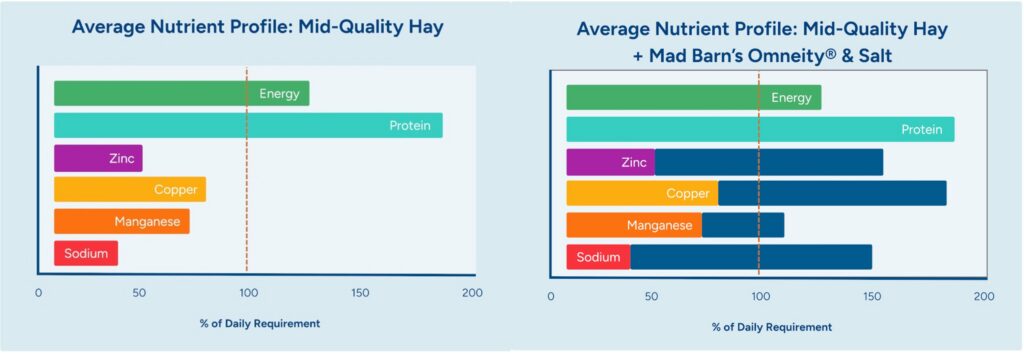
Subclinical nutrient deficiencies can affect hoof growth, coat condition, topline, exercise recovery and overall resilience before more obvious signs appear. Most equine diets include excessive amounts of calories and protein, which highlights the importance of increasing vitamin and mineral intake without adding more energy or grain to the diet.
How to Identify Quality Equine Vitamin and Mineral Supplements
When choosing a vitamin and mineral supplement for your horse, ensure it’s been formulated based on the National Research Council (NRC) recommendations and then assess whether the product provides enough micronutrients to balance your horse’s grain ration at the recommended feeding rate.
Horse owners should also review the guaranteed analysis and ingredient list. A high-quality supplement should provide essential trace minerals, including copper, zinc, selenium and manganese. Ideally, these minerals should be supplied in organic or chelated forms, which are generally more bioavailable than inorganic sources.
The label should also show meaningful vitamin fortification, especially vitamins E and A, since these are often low in hay-based diets. A complete B-vitamin profile is another valuable feature, particularly for horses with higher demands related to growth, training, stress or hindgut issues.
If you’re concerned about your horse’s hoof quality, look for a supplement high in biotin to support keratin synthesis and hoof growth. It should also contain the limiting amino acids lysine, methionine and threonine, which are important for muscle protein synthesis and support topline development, hoof growth and exercise recovery.
It’s equally important to look at what supplements don’t contain. Added iron is usually unnecessary because most horses already consume more than enough iron from forage and water. Excess iron can interfere with copper and zinc absorption and make balancing your horse’s diet more difficult.
Finally, the formula should be concentrated enough to balance a forage-based diet without adding unnecessary sugar, starch, calories or filler ingredients. This is especially important for easy keepers and metabolic horses, who benefit from a low-NSC diet.
Omneity®: Best Option for Most Horses
Omneity® is a great choice for most horses on forage-based diets or grain. It was formulated by equine nutritionists using data from thousands of horse diets to address common vitamin and mineral gaps in a single product. As a result, many horses don’t need separate hoof, coat or balancer supplements.
Omneity® provides 100% organic trace minerals, complete B-vitamin fortification, research-backed levels of biotin, essential amino acids, yeast and digestive enzymes. It also contains no added iron and is formulated to be low in sugar and starch. These ingredients work to support hoof quality, coat condition, topline development, antioxidant status, digestive health and overall well-being.
Omneity® is available in a loose powdered premix and as pellets, depending on your horse’s taste preference. The premix is the most cost-effective option, while the pellets are useful for picky horses and fit more easily into a wider range of feeding routines.
AminoTrace+: Best for Horses with Special Health Considerations
For horses that need more targeted nutritional support than a standard all-in-one balancer, AminoTrace+ is a better choice. It was developed for horses with metabolic issues such as insulin resistance, EMS and PPID, but it’s also an ideal option for horses with poor hoof quality, high-iron forage or higher demands related to training and recovery. It provides high-quality ingredients, enhanced nutrient levels and addresses several common problems with one product.
Compared to Omneity®, it provides higher levels of copper and zinc to help correct mineral imbalances in high-iron diets, along with magnesium, natural vitamin E and the limiting amino acids lysine, methionine and threonine. Together, these nutrients support robust hoof strength, topline development, antioxidant status, immune health, muscle function and metabolic health.
AminoTrace+ also includes 20 mg of biotin per serving, targeted digestive support from yeast and prebiotics and no added iron. Its low-NSC pelleted formula makes it well-suited for horses that need lower sugar and starch intake to support insulin regulation and weight management.
How to Choose a Vitamin and Mineral Supplement
The right supplement for your horse depends on several factors, including his nutrient requirements, his current diet and what your horse will reliably eat. The goal is to choose one complete product that balances his diet without adding unnecessary calories or requiring multiple overlapping supplements.
For most horses, Omneity® is the best place to start. It’s designed as a complete daily balancer for forage-based diets and grain feeding programs. Within the Omneity® line, the premix is the better fit for horses that accept powdered supplements well or already receive another carrier feed such as mash, soaked feed or beet pulp. The Omneity® pellets are often the better choice for picky horses or when simplicity at feeding time is a priority.
AminoTrace+ is the better option if your horse needs a more concentrated nutrient profile. This includes horses with EMS, PPID, insulin dysregulation, a history of laminitis, poor hoof quality, high-iron forage or greater needs for metabolic support, hoof health and topline development.
Take the Guesswork Out of Your Horse’s Diet
Choosing the right vitamin and mineral supplement starts by understanding what’s missing from your horse’s diet and his individual needs. It’s also important to consider your horse’s lifestyle, health status and performance goals. The goal of supplementation is not to simply add more nutrients to your horse’s diet, but to supply the right nutrients in balanced amounts to support his long-term health, performance and overall condition.
This is the same process Mad Barn’s professional nutritionists use when working with horse owners. We evaluate your horse’s entire feeding program, including forage, grain or concentrates, added supplements and his individual requirements. From there, we recommend the solution that best balances his ration. Our goal is to simplify your horse’s diet where possible while also helping you avoid unnecessary supplement costs.
For most horses, Omneity® is the best vitamin and mineral supplement because it provides broad daily nutritional support and gives horse owners confidence that the diet is fully covered. When a horse has higher nutrient demands or more specific challenges, such as metabolic concerns, poor hoof quality or high-iron forage, AminoTrace+ provides a more targeted nutrient profile.
For personalized guidance, use Mad Barn’s Equine Nutrition Calculator or submit your horse’s diet for a free custom ration balancing by a Mad Barn equine nutritionist.
To learn more about Mad Barn, click here.