




 Video
VideoQ: I found your Practical Horseman article “Relax Your Body to Ride Better & Reduce Pain” on how to tell if you’re overusing the wrong muscles in the saddle very interesting. I definitely think I’m overusing my stationary stabilizers. My lower back is consistently sore after I ride, I struggle to engage my core in the saddle and I don’t feel like I’m as elastic as I could be. Are there any ways I can retrain my muscles to correct this?
— Kim S., Pennsylvania
A: What you’re describing is extremely common among conscientious riders—especially those who try very hard to sit “correctly” by holding themselves stable in the saddle.
Often, when the body doesn’t feel truly organized from the inside, riders compensate by overusing what I call the stationary stabilizers: the lower back, hip flexors, glutes and larger postural muscles that tend to brace and hold. The result can be exactly what you describe: a sore lower back, difficulty accessing the deep core naturally, reduced elasticity and a feeling that your seat is working harder than it should.
The good news: This usually isn’t a strength problem. In many cases, it’s a coordination and awareness problem. The body has to learn how to distribute effort more efficiently so movement can travel through the pelvis, spine, ribs and hips without unnecessary holding. When that begins to happen, riders often notice:
- less gripping and bracing,
- easier breathing,
- a more responsive core,
- improved suppleness,
- and a much more effortless connection with the horse.
Work Smarter, Not Harder
The stationary stabilizers are deep muscles designed to hold the joint in place, not move it. Many riders unknowingly over-recruit these when they try to sit still, brace for balance or attempt to be correct. When stabilizers grip too hard, the pelvis stops moving, the back becomes rigid and the rider loses the ability to follow the horse’s gait. Studies show that increased stabilizer tension directly reduces pelvic mobility and following ability.
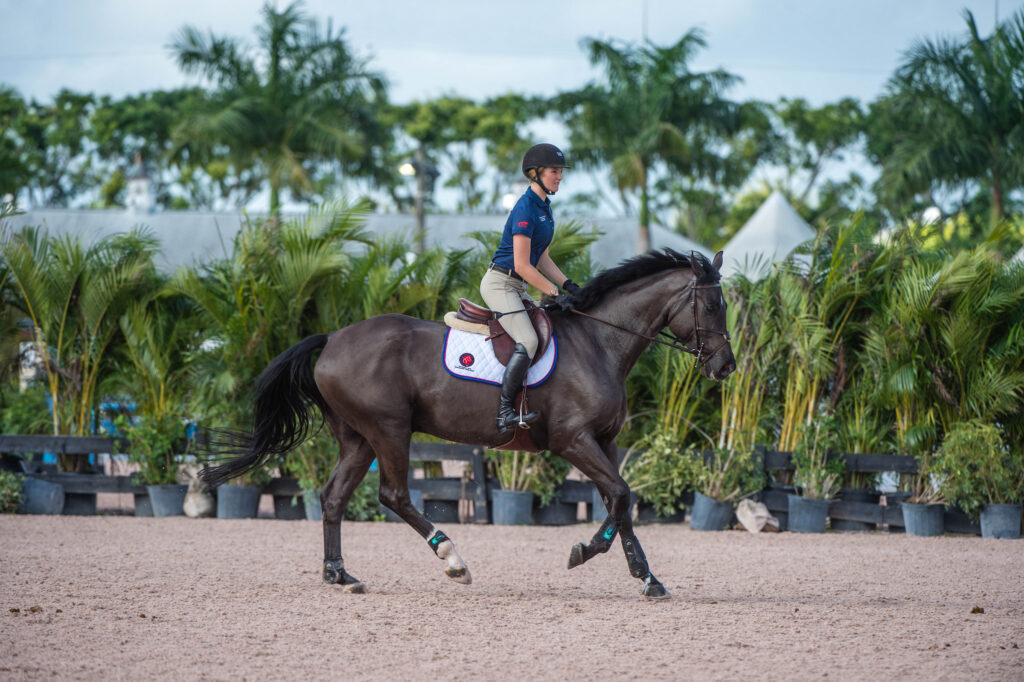
Here are five practical tips that can help:
1. Spend time noticing where you brace before trying to “fix” it.
2. Allow your breath to move through your ribs and back while riding.
3. Think of balance as dynamic and responsive rather than held or fixed.
4. Work slowly enough so your nervous system can actually sense differences.
5. Alternate moments of riding with moments of rest and reflection so your body can better absorb new patterns.
In my experience, meaningful change happens less through forcing muscles to work harder and more through retraining how the nervous system organizes movement and support. I hope these tips help you use coordination and awareness to improve your seat and become a more elastic rider without overusing the wrong muscles in the saddle!
Submit Your Question to Team Prac!
Team Prac—our group of top trainers representing hunters, jumpers, eventing and dressage—is here to provide useful and impactful advice to help you improve your skills in the saddle and develop a harmonious partnership with your horse.
To submit your question, sign up for Practical Horseman+ for only $3.99 a month. (Learn more about all the benefits you’ll enjoy as a member of Practical Horseman+, our new, exclusive membership platform, here!) We’ll ask a little bit about you and your horse and what type of issue you’re seeking help with. From there, we’ll pass your question on to a Team Prac member who specializes in your discipline. Already a Practical Horseman+ member? Click here to submit your question.
If your question is selected, it will be featured in a future Practical Horseman and/or Dressage Today digital article and on our social media channels to help you and other riders who might be struggling with a similar issue. We look forward to helping you and your horse on your journey together!