




 Video
VideoBright and early on the final day of Boyd and Silva Martin’s 2026 Windurra Camp—the couple’s third annual action-packed weekend of education and one-on-one instruction—Practical Horseman got the chance to participate in the camp’s yoga class with Boyd’s longtime instructor Biz Magarity.
In Part 1 of this two-part series, Magarity detailed the physical and mental benefits yoga offers equestrians and how the practice has been game changing for Boyd’s performance in the saddle. She also explained the important role yoga plays in rider longevity and how you can easily get started if you’re new to the practice. (Catch up on Part 1 here.)
In Part 2, we highlight a few of the movements that Magarity coached participants—and this amateur yogi—through during Windurra Camp’s yoga class, while Boyd demonstrated along with periodic assistance from the Martin family’s dog Sugar.
It All Starts With Your Breath
Even if you know very little about yoga, you’ve probably heard that breathing is key to the practice.
“The great thing about breath is that it has a direct impact on our nervous systems,” Magarity said. “It can wake you up on a sleepy, early day; it can help you fall asleep; and it can help bring focus when you need it.”
To establish our breathing and settle our minds, Magarity asked us to start in a lying position with our knees bent and our feet on the floor about as wide as our mats.
“You want to think of the abdomen as two sections: the lowest section and the upper section. Place your left hand on the lower part of your abdomen with your left thumb at your belly button,” she instructed. “Put your right hand over your breastbone so your right thumb is at your sternum.
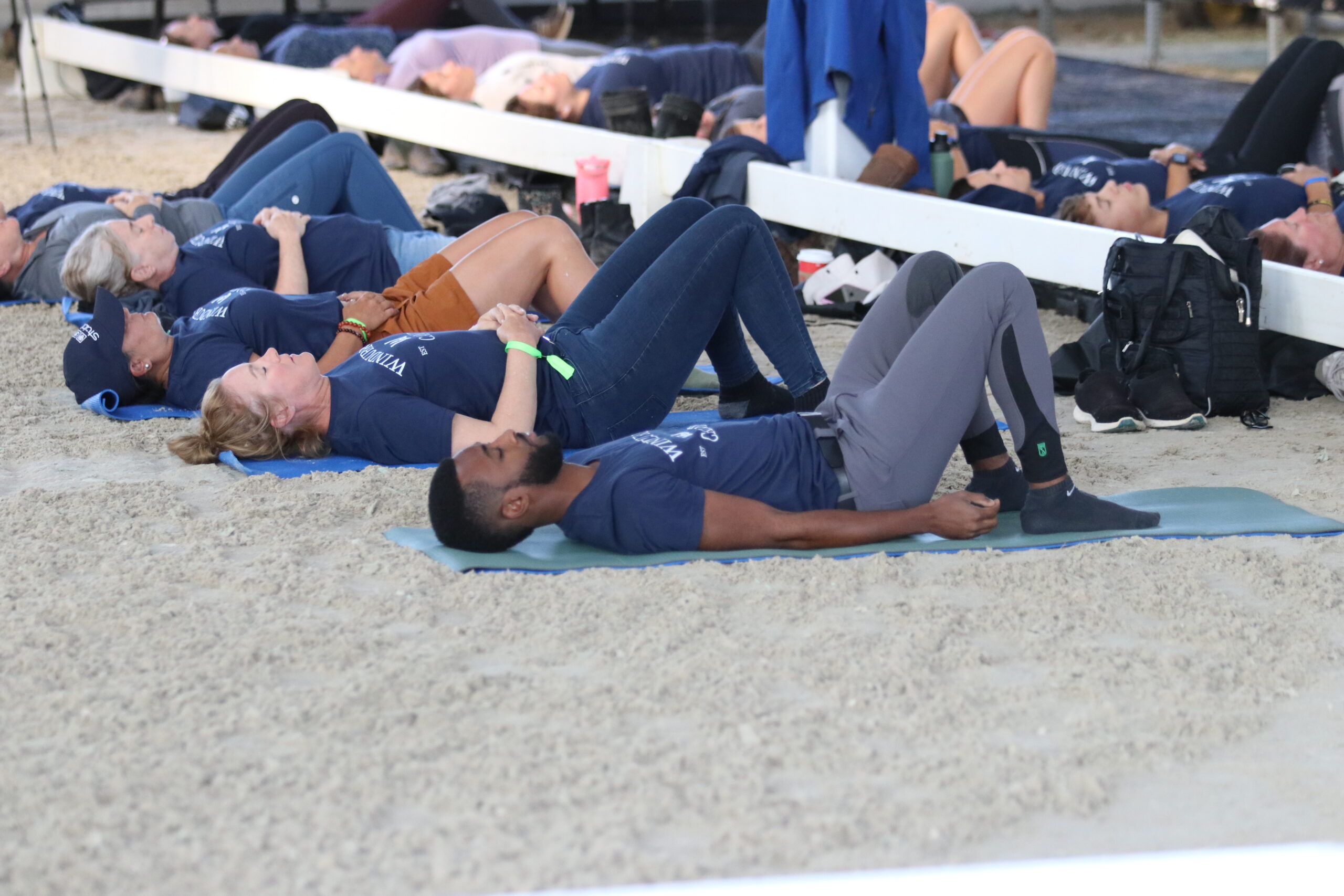
“Now, we’re going to do a two-part inhale,” she continued. “Think about breathing down your left hand, briefly hold it, and then continue with that same inhale breathing all the way into your right hand in the upper part of your trunk. Hold again, like you’re trying to stop the breath right in front of your throat and then exhale.”
Magarity walked us through several rounds of this breathing pattern, before instructing us to take a regular, deep breath in through the nose. “You should feel your belly pop out a little with your left hand and your ribs flare as your whole chest fills with air,” she said. “Hold the breath for a moment and exhale all the air from your lungs before inhaling again.”
Breathing Through the Sides and Twisting
Next, Magarity had us come into a seated position with both legs extended in front of us. “Cross your right ankle over your left. If your right hip pops up, try to press it down into the mat. Interlace your fingers, bring your arms out in front of you and gently pull them to the left, so you should really feel a stretch in the right side of your body. Think about breathing through the right side of your ribcage as you feel those muscles open up.
“Next, bring your right knee into your chest and cross it over your left leg so your right leg is in a triangle position. You can hold your right knee with your left hand as you stretch your right arm up to the ceiling so you’re taking a little twist to the right,” Magarity instructed. “Take a deep breath in and extend your arm all the way out to the right as you exhale while watching out for your neighbor.”
She had us repeat this several times before stretching and breathing through the left side. “Just like with horses, we always want to do things evenly on both sides,” she said.
Tabletop for Cat and Cow
Next, Magarity had us assume a tabletop position (where you balance evenly on your hands and knees while maintaining a flat back) to prepare for a version of “cat and cow.”
“In tabletop, it’s tempting to let your elbows flail out to the side when you bend them. When this happens, your shoulders roll forward and scrunch up toward your ears. Instead, rotate your arms from the shoulder so your elbows are pointing back toward your hips; this way when you bend them, it activates the muscles on the outside of the shoulder and the back of the arm. This same principle applies in downward dog.
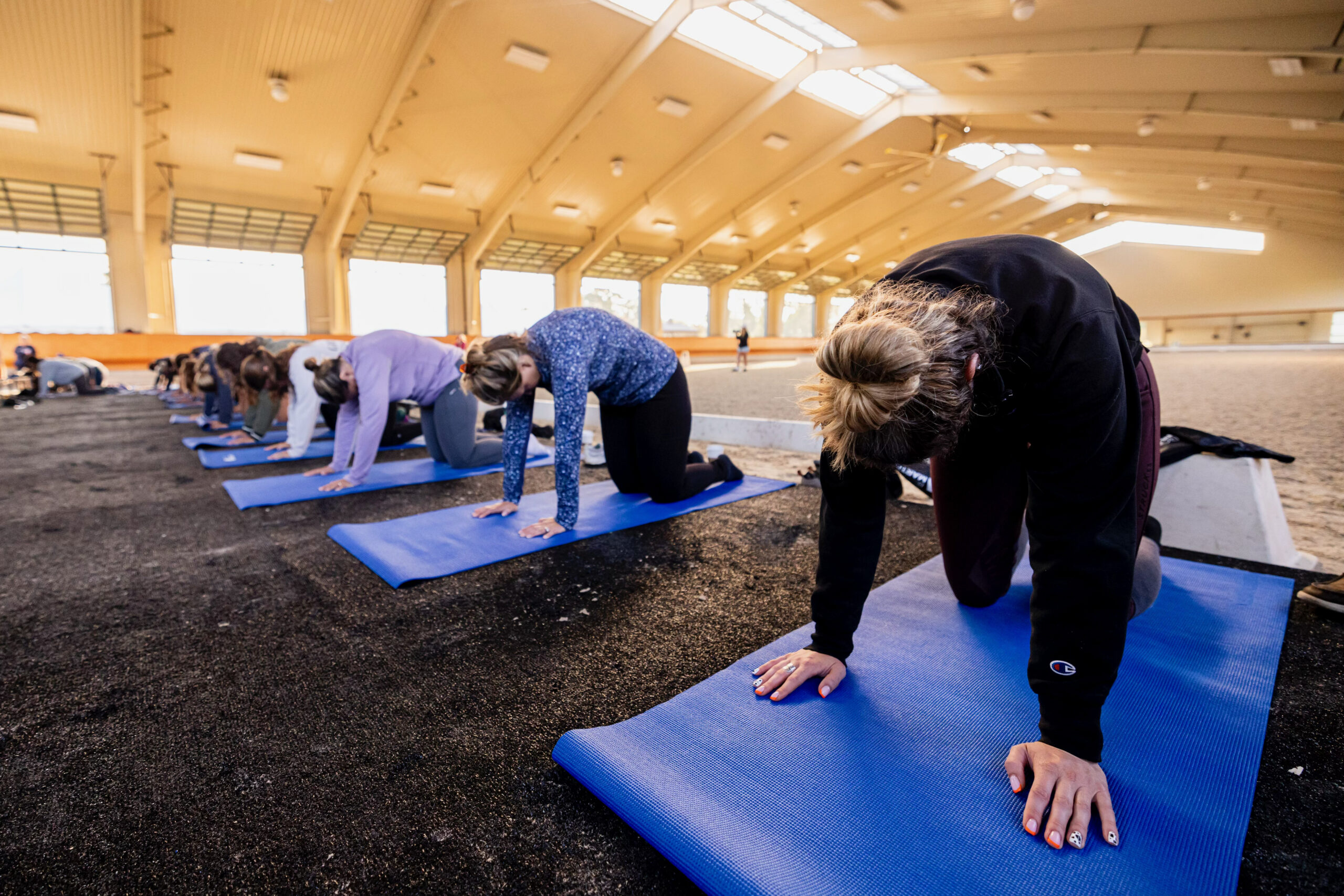
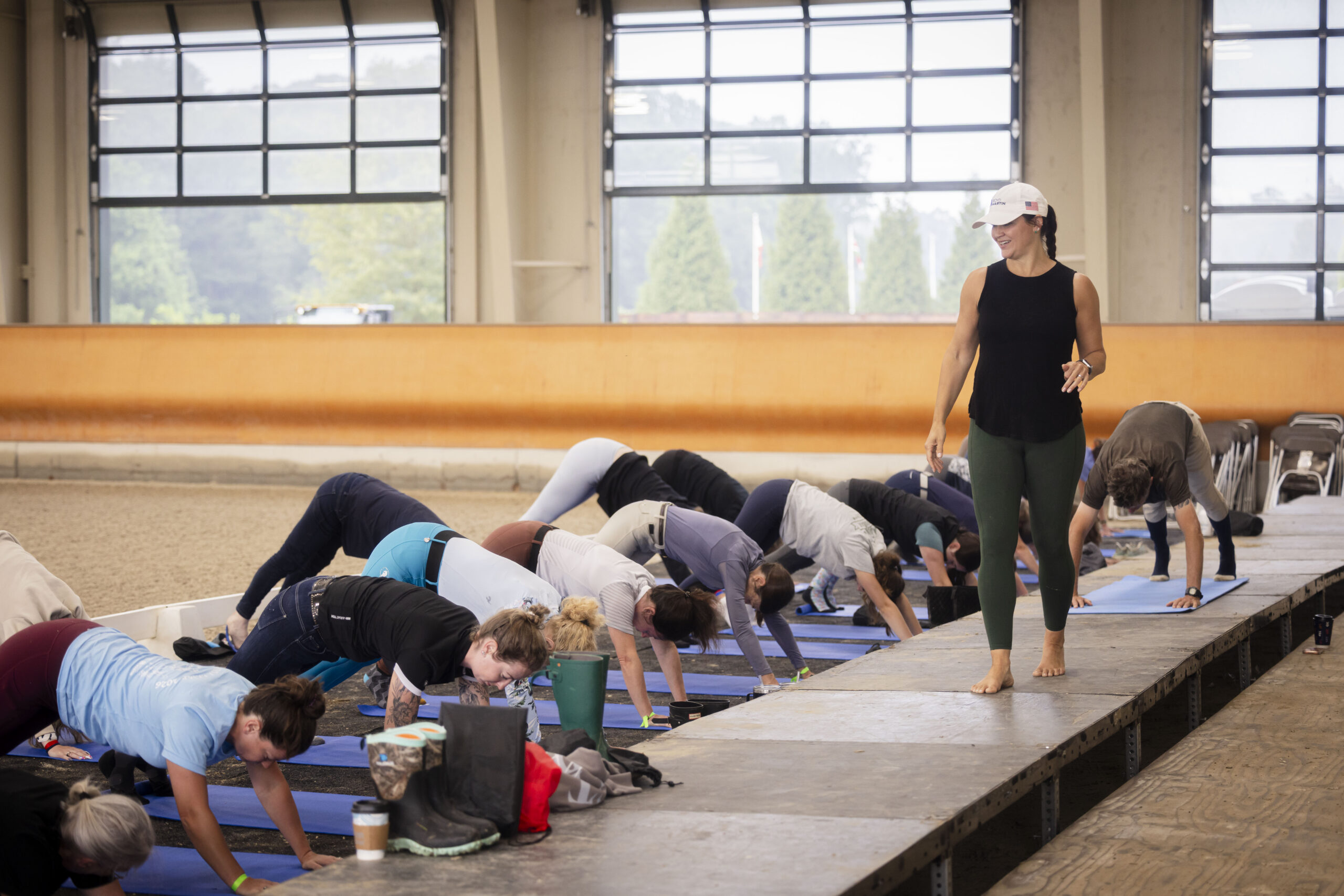
“Inhale as you arch your back, lift your chin and open your chest for ‘cat’ and then exhale as you round your back before lifting your hips up into downward dog for ‘cow.’ If your hamstrings are still a little tight, keep your knees slightly bent. Now, bend your elbows again keeping them close to your sides. It’s more work on your arms, but it creates more strength in the shoulders,” she said. “Then, wobble your head around to make sure your neck isn’t working and release your knees to the floor back into tabletop. We’ll repeat this several times and then finish in child’s pose by bringing your hips to your heels.”
If your wrists get sore in positions where you’re on your hands, Magarity said you can also make fists and balance on your knuckles.
Windshield Wipers to Calm the Body
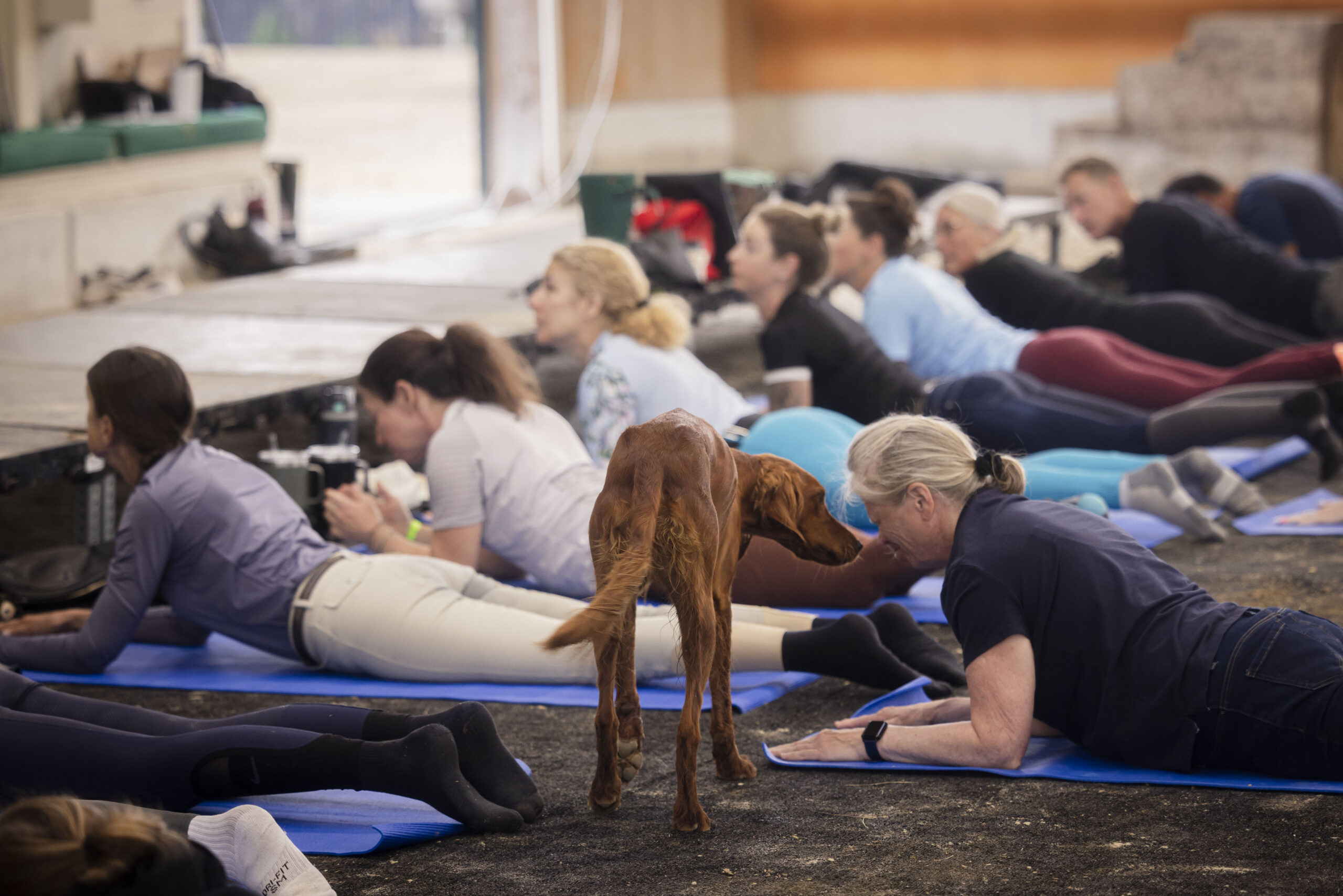
Next, Magarity instructed us to lie face down on our stomachs while relaxing our faces between our hands. “Bend your knees so your feet are facing the ceiling and windshield-wiper your feet from side to side. When you lie face down, all the nerve endings in your spine come forward and help calm the nervous system,” she said. “This is a good movement anytime you might need a break during the class.”
Plank and Downward Dog Series
Magarity next had us come into a high plank. “Exhale and push back into downward dog. Inhale and go back into high plank. Exhale back into downward dog; inhale and lift your right leg up behind you without kicking your neighbor and step your right foot all the way forward so you’re in a hamstring stretch. Extend your right arm up as you inhale for a twist, and we’ll repeat that three times.
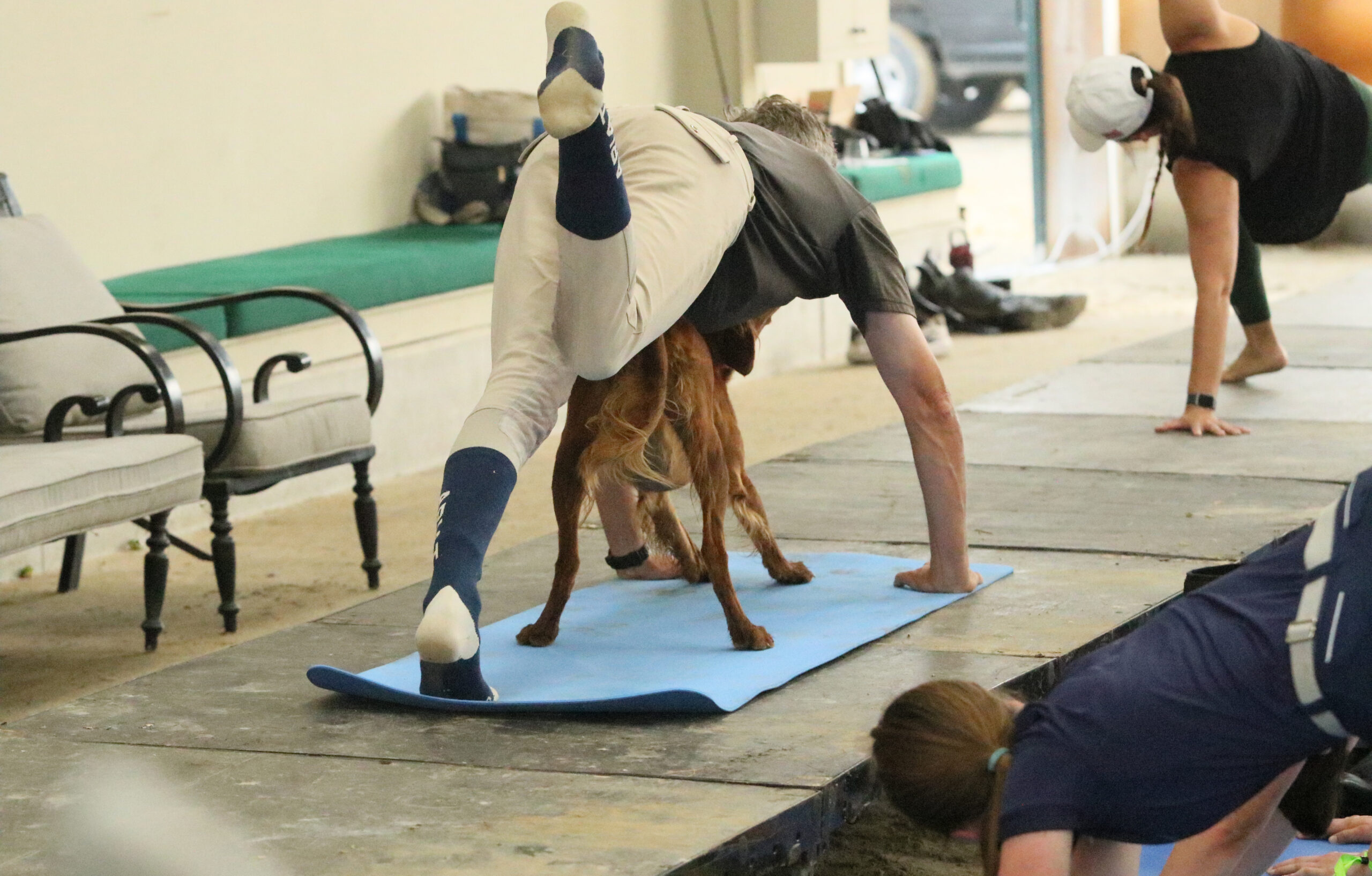
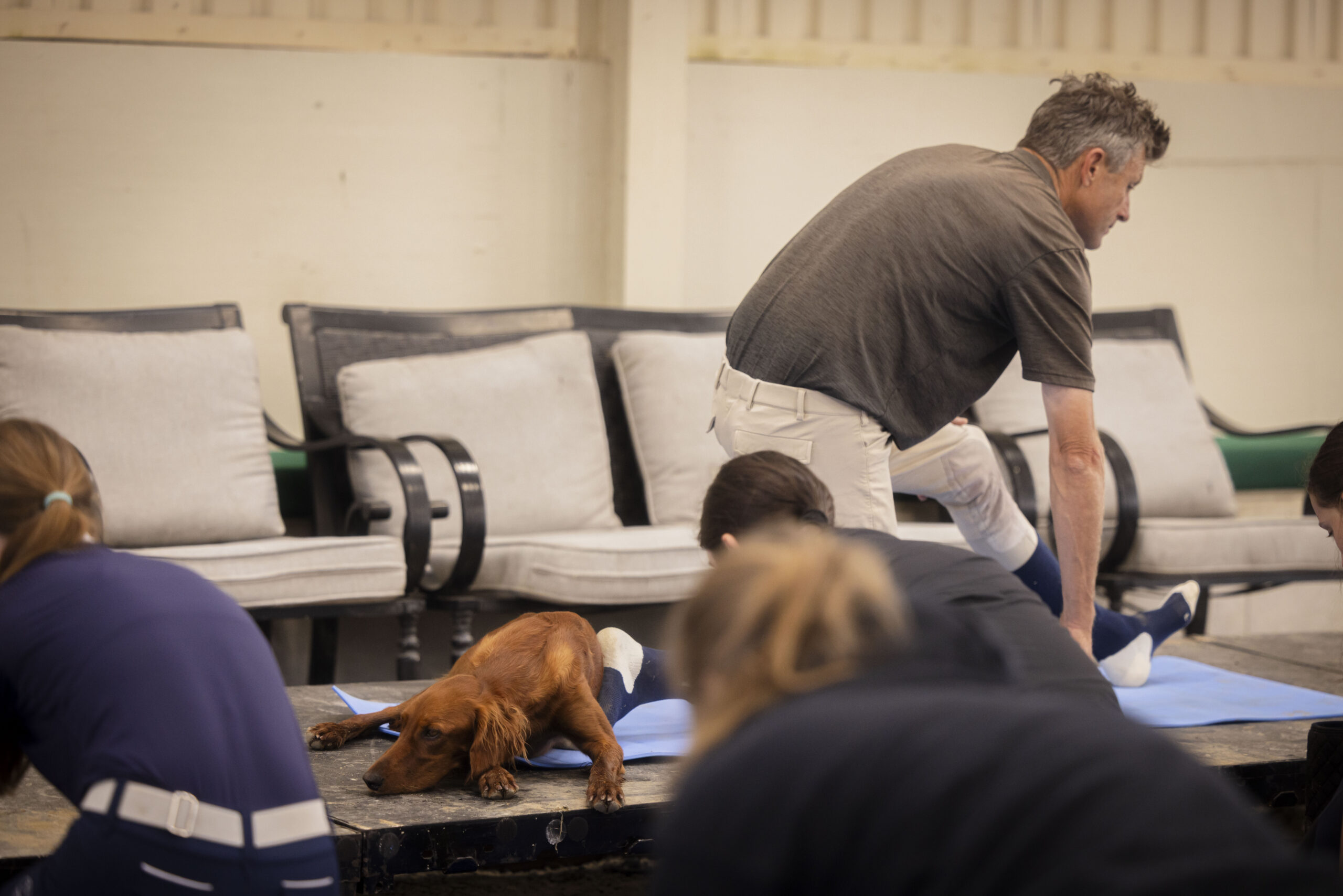
“Then, we’ll repeat the plank and downward dog flow again and then step your left foot forward for the same inhale-and-twist movement to the left,” she continued.
Meditation
One of the huge benefits of yoga, Magarity said, is that it teaches you how to use your breath to calm down any time you get frustrated, anxious or even overheated. “Some people can do this easily. For other people, when they’re still, their brains and nervous systems tend to go crazy,” she said. “If you’re the kind of person who has trouble sitting still, this part of our session may be challenging.”
Magarity instructed us to face the open area of the arena and find a comfortable seated position while keeping our spines long. “This meditation session is going to be a little different because I want you to start it with your eyes open. Find a focal point. It can be a shadow or a divot in the sand.
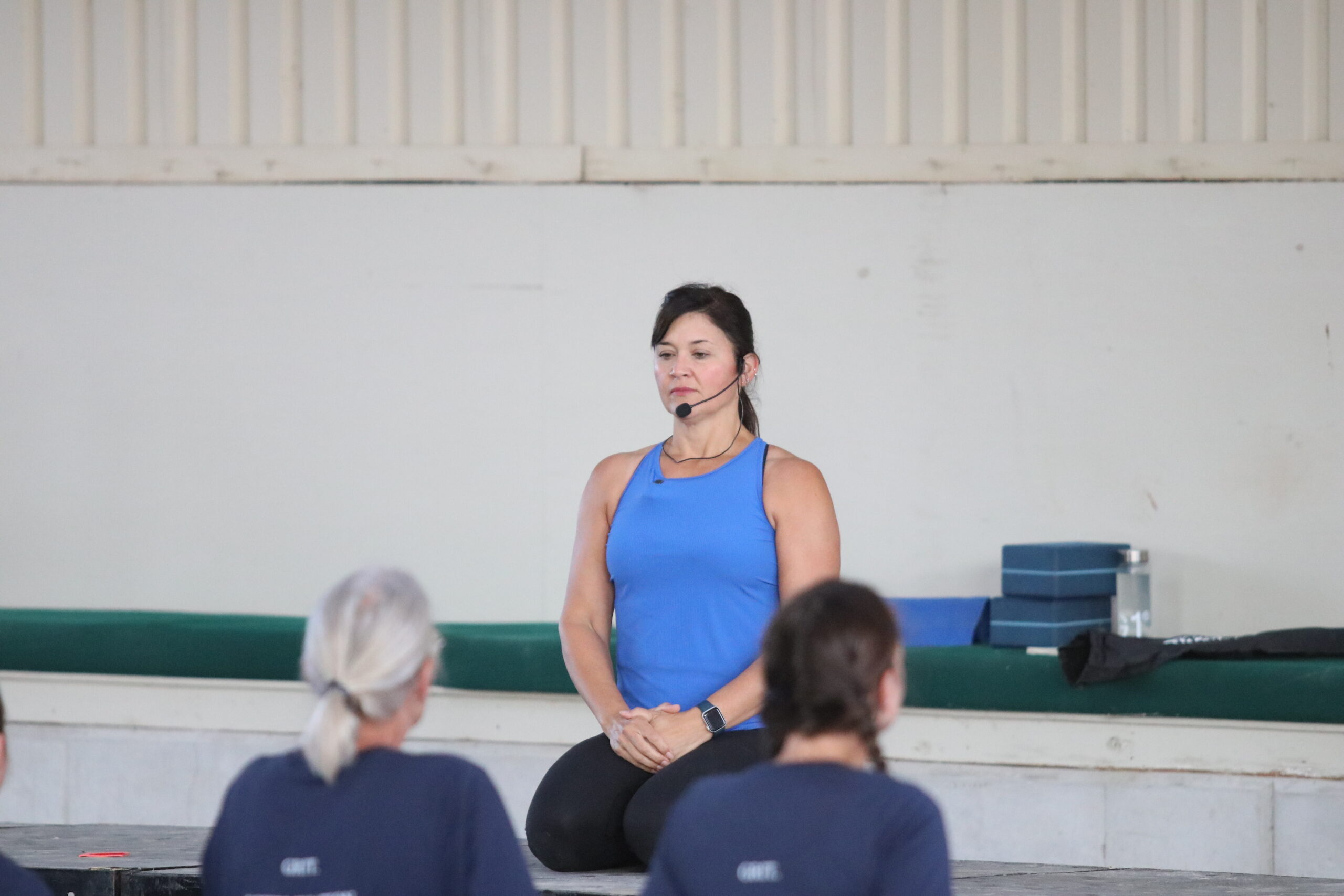
“Do a couple of deep breaths and blink a lot to get your eyes moist. Then open your eyes and stare at your focal point while trying not to blink. When a thought pops into your head, or your stomach growls and you start to wonder what’s for breakfast, tell your brain to ignore it, widen your eyes, and stare at your focal point,” she said. “You can even name it if you want to.”
(I named mine “Wilson” after Tom Hanks’ volleyball friend in the 2000 film “Cast Away.”)
As we continued to stare at our focal points, Magarity asked us to consider how our visual fields started to change. “Maybe the periphery gets sharper, maybe it gets duller. Sometimes you might notice different colors, or something appears brighter,” she said.
(For me, the periphery got duller, and Wilson got sharper; I also noticed more of a rose-colored light.)
“Now, close your eyes and take the heels of your hands and press them lightly against your eyes while keeping your head in the same position as you had with your eyes open. Your eyes might feel warm under your hands and almost like they’re tearing up a bit.
“Drop your hands and again keep your head in the same position like you’re still looking at your focal point. Even with your eyes closed, you’re probably seeing what looks like a photo negative of the focal point you were staring at,” Magarity said. “Your mind still knows it’s there.”
(I definitely saw a negative of Wilson!)
Takeaway
I turned 47 about two months before Boyd did this past summer. While I’m undoubtedly not an Olympic eventer, I’ve found my personal yoga practice extremely beneficial my riding, and I very much appreciate what Magarity mentioned about Boyd’s fitness routine in Part 1 of this series:
“The yoga and fitness and overall health routine that Boyd has created for himself is all about how he can stay in this game for another decade or so and perform to his full potential.”
As a proud adult amateur hunter/jumper, I, too, aspire to stay in the saddle for as long as I can.
We hope this series from Windurra Camp’s yoga lesson better explained the sometimes elusive benefits the practice offers riders and inspires you to give yoga a try if it’s not already part of your non-riding exercise routine. You just might be surprised by the many ways it can transform your physical and mental game in the saddle.